
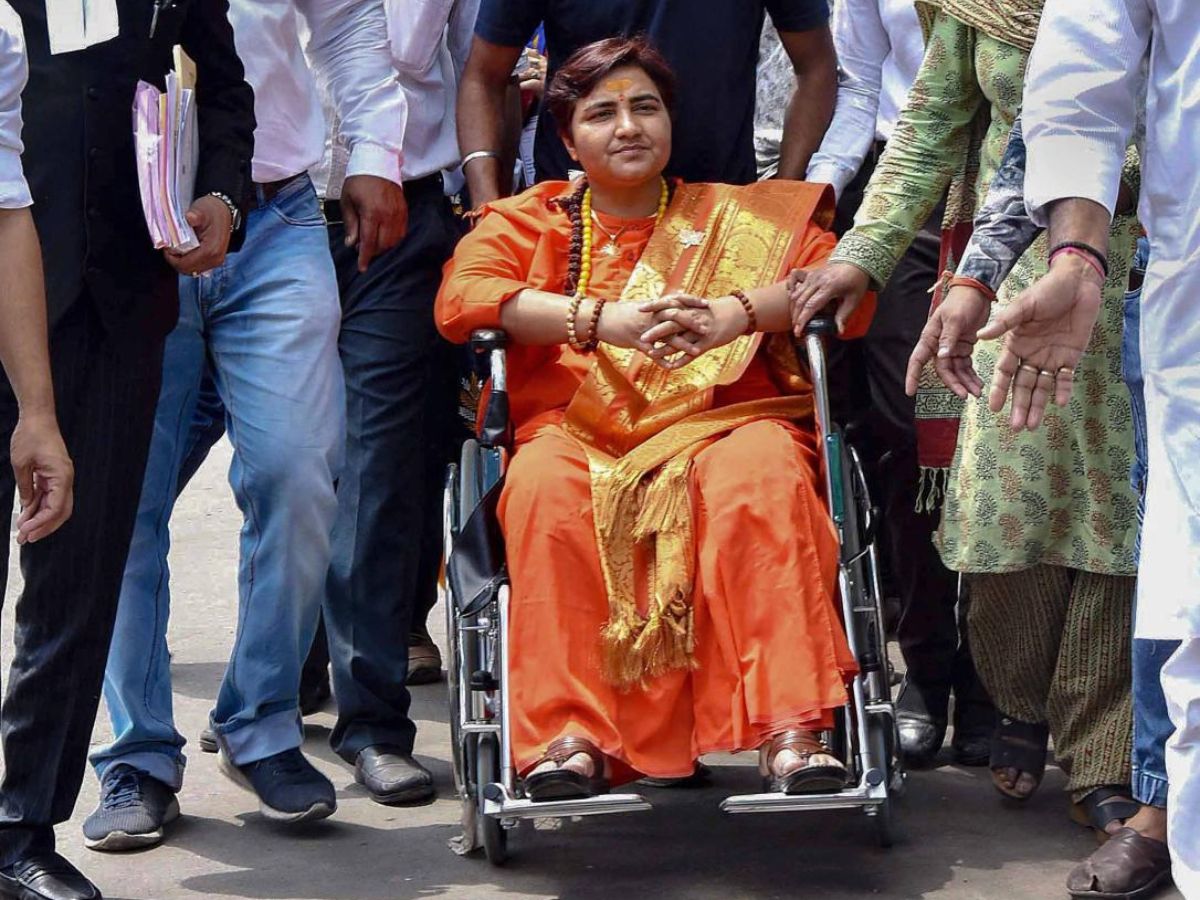
Over 17 years after a bomb ripped through Bhikku Chowk in Malegaon, killing six and injuring 95, the Mumbai NIA Special Court on Thursday acquitted all seven accused in the case, including BJP MP Sadhvi Pragya Singh Thakur. While the courtroom reverberated with the words of a verdict that cited lack of evidence and prosecutorial lapses, it was the emotional outburst from Thakur that left a lasting impression.
“I Was Branded Guilty Despite Being Innocent”
Breaking down before Judge A K Lahoti, Sadhvi Pragya said, “I have endured years of humiliation. I had to struggle repeatedly. Despite being innocent, I was branded with the stigma of guilt. This ruined my whole life.” Her voice choked as she addressed the court, recounting the years spent under trial, ostracized and accused.
Once seen as the face of what was controversially termed “saffron terror,” Pragya Singh Thakur described the years of trial as a deep personal and spiritual wound. “I was living a sage’s life, but I was made an accused. I am alive because I am a sanyasi,” she said. “They defamed the Bhagwa through a conspiracy. Today, Bhagwa has won, and Hindutva has won. God will punish those who are truly guilty.”
A Motorcycle That Didn’t Hold Up in Court
At the heart of the prosecution’s case was a motorcycle that investigators said was used to plant the bomb. Registered in Sadhvi Pragya’s name, the LML Freedom bike was considered the key to the alleged conspiracy. However, Judge Lahoti ruled that the prosecution failed to prove a direct link.
“The bike allegedly involved in the blast did not have a clear chassis number. The prosecution could not prove it was in (Pragya Thakur’s) possession immediately before the blast,” the verdict said. With that, the court dismantled what had long been presented as the central piece of evidence.
Flawed Investigation, Contaminated Evidence
Beyond the motorcycle, the court expressed serious concerns about the quality of investigation carried out initially by the Maharashtra Anti-Terrorism Squad (ATS). “No sketch of the spot was done by the investigation officer while doing the panchnama. No fingerprint, dump data or anything else was collected from the spot,” the judgment said.
There were also discrepancies in medical evidence. “Court has come to a conclusion that injured people were not 101 but 95 only, and there was manipulation in some medical certificates,” Judge Lahoti noted, further weakening the prosecution’s case.
The Accused and the Long Legal Battle
Seven individuals stood trial in the final phase of the case: Sadhvi Pragya Singh Thakur, Major (Retd) Ramesh Upadhyay, Sudhakar Chaturvedi, Ajay Rahirkar, Sudhakar Dhar Dwivedi (also known as Shankaracharya), and Sameer Kulkarni. Originally, 11 people were accused. Over time, four were discharged due to lack of evidence.
The trial, which began in earnest in 2018, included hundreds of witnesses and a high volume of forensic and circumstantial evidence—much of which failed to hold up in court.
Prosecution Could Not Prove the Conspiracy
In the final analysis, Judge Lahoti stated that while the blast itself was proven, the prosecution failed to establish that the bomb was placed in the said motorcycle, or that the accused conspired to execute the act. He further noted that the application of the anti-terror law UAPA was legally defective, as the required sanctions were not obtained correctly.
State Ordered to Compensate Victims
While acquitting the accused, the court directed the Maharashtra government to pay ₹2 lakh each to the families of the deceased and ₹50,000 to the injured victims. Though this order offers some restitution, it doesn’t erase the questions raised over the credibility of the investigation and the years lost by those who stood trial.
The Political and Personal Fallout
For Pragya Thakur, who later became a Member of Parliament, the case was both a political label and a personal torment. “Those who defamed India and Bhagwa have now been proven wrong. This is not just my victory. This is the victory of saffron,” she said outside the courtroom.
The Malegaon blast case is now legally concluded, but the deep polarization it reflected in India’s political and social fabric may take far longer to heal.