
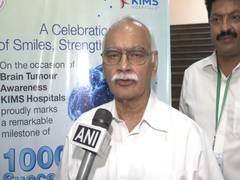
Hyderabad (Telangana) [India], June 7 (ANI): Marking a major milestone in advanced healthcare, KIMS Hospitals, Secunderabad, on Sunday announced the successful completion of over 10,000 brain tumour surgeries.
To commemorate World Brain Tumour Day, Dr B Bhaskar Rao, Chairman and Managing Director (CMD) of KIMS Group of Hospitals, unveiled a state-of-the-art Robotic Digital Microscope designed to enhance precision in complex neurosurgeries.
Speaking on the occasion, Dr Bhaskar Rao emphasised how rapidly evolving medical technology is simplifying complex surgeries and accelerating patient recovery.
“The newly launched Robotic Digital Microscope will be a game-changer in treating intricate brain and spinal cord disorders. Early detection coupled with cutting-edge technology like Gamma Knife Radiosurgery, which is available at KIMS, makes successful treatment highly achievable,” he said.
Dr Rao also raised concerns over modern lifestyle shifts, noting that prolonged usage of smartphones, laptops, and high-volume earphones, combined with a lack of physical activity among the youth, could severely impact brain health.
Highlighting the clinical aspects, Dr Manas Kumar Panigrahi, Senior Consultant Neurosurgeon, warned against the common habit of dismissing recurring headaches.
“A persistent headache, especially one that is severe upon waking up in the early hours of the morning, should never be ignored. It could be an early warning sign of a brain tumour,” Dr Panigrahi cautioned.
He revealed that nearly 10% of the 10,000 surgeries performed at KIMS were on children, debunking the myth that brain tumours only affect older demographics.
Explaining the utility of the new robotic equipment, Dr. Panigrahi stated that neurosurgeries demand extreme precision due to the delicate nature of the brain and spinal structures.
The Robotic Digital Microscope offers high-definition clarity, helping surgeons distinguish between healthy brain tissue and tumours, thereby minimising collateral damage and ensuring safer outcomes in spine surgeries and nerve decompressions.
Dr Panigrahi made a strong case for policy changes in preventive healthcare, noting that routine master health check-ups and standard insurance packages extensively cover cardiac evaluations but completely omit brain scans. He urged the inclusion of brain screenings in standard health packages to facilitate early diagnosis and save lives.
Echoing similar concerns, Consultant Neurosurgeon Dr Shwetha outlined the varied symptoms of brain tumours, which depend heavily on the tumour’s size and location. Apart from progressive headaches, symptoms include Vomiting and blurred or double vision, Seizures (fits), Weakness in limbs, slurred speech and Memory loss and sudden behavioural changes.
“Brain tumours are among the most common cancers found in children, and we are increasingly seeing cases among youth and the middle-aged,” Dr Shwetha said.
She advised the public to adopt healthy lifestyles, avoid self-medication for chronic headaches, and seek immediate consultation from neurologists or neurosurgeons when symptoms arise.
The event was attended by a team of neuro-experts, including Dr Chandrasekhar Naidu, Dr Sujith Kumar, Dr Vijayanth, Dr Gopal Krishna, and Dr CVS Dasaradhi, alongside several recovered patients and children. To mark the occasion, a special painting competition was organised for children, and prizes were distributed to the winners. (ANI)
The article has been published through a syndicated feed. Except for the headline, the content has been published verbatim. Liability lies with original publisher.