
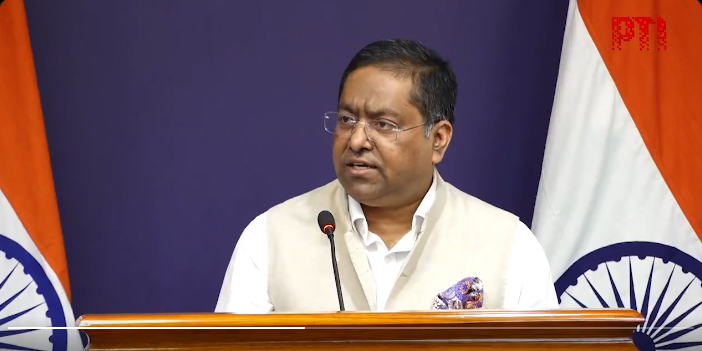
India has pushed back firmly against remarks by NATO Secretary-General Mark Rutte, who warned countries like India, China, and Brazil of potential secondary sanctions over continued trade with Russia. Calling out what it described as “double standards,” the Indian government defended its sovereign right to secure energy for its population.
The Ministry of External Affairs (MEA), in a weekly briefing on Thursday, made it clear that India’s energy security remains a non-negotiable priority, and decisions on oil imports are driven by national interest, market availability, and global conditions—not external pressure.
“We have seen reports on the subject and are closely following the developments,” said MEA spokesperson Randhir Jaiswal. “Securing the energy needs of our people is understandably an overriding priority for us… We would particularly caution against any double standards on the matter.”
NATO Chief’s Warning Sparks Diplomatic Discomfort
NATO’s newly appointed Secretary-General Mark Rutte made the controversial remarks while addressing U.S. lawmakers in Washington. Rutte said countries like India could face serious consequences if they continued economic engagement with Russia amid its ongoing war in Ukraine.
“If you live now in Beijing, or in Delhi, or you are the president of Brazil, you might want to take a look into this, because this might hit you very hard,” Rutte said. Please make the phone call to Vladimir Putin and tell him that he has to get serious about peace talks, because otherwise this will slam back… in a massive way.”
The remarks were widely interpreted as a warning of secondary sanctions or trade penalties, similar to those imposed on companies and states doing business with Russia after its 2022 invasion of Ukraine.
India’s Stance: No Apologies for Energy Security
India, which has significantly increased purchases of discounted Russian crude since 2022, has consistently maintained that its position is based on national interest and neutral diplomacy. The Country has neither condemned nor endorsed Russia’s actions in Ukraine, instead advocating for dialogue and diplomacy to resolve the crisis.
Union Petroleum Minister Hardeep Singh Puri, responding to the latest threat, said India was well-prepared to deal with any disruption in supply.
“I’m not worried at all. If something happens, we’ll deal with it,” said Puri. “India has diversified the sources of supply and we’ve gone from buying from 27 countries to about 40 now.”
EU, NATO Members Continue Russian Energy Imports
India’s sharp reaction also highlights the perceived Western hypocrisy in the matter. Despite pushing for a global boycott of Russian energy, several European Union and NATO countries remain major buyers of Russian oil and gas.
According to the Centre for Research on Energy and Clean Air (CREA):
-
The EU has been the largest buyer of Russian LNG and pipeline gas since 2022.
-
Turkey, a NATO member, is the top importer of Russian oil products.
-
The EU plans to phase out Russian fossil fuels only by 2027 (oil) and 2028 (gas)—a timeline that continues to allow significant trade in the meantime.
India’s messaging, therefore, appears aimed at calling out selective enforcement of sanctions and unequal pressure applied on non-Western countries.
What’s Really at Stake?
India’s reaction highlights a broader truth: Global South nations are tired of being strong-armed into Western geopolitical alignments while watching Western countries quietly flout the very rules they preach.
India is asserting a new reality—strategic autonomy—balancing its interests without choosing sides in superpower conflicts.