
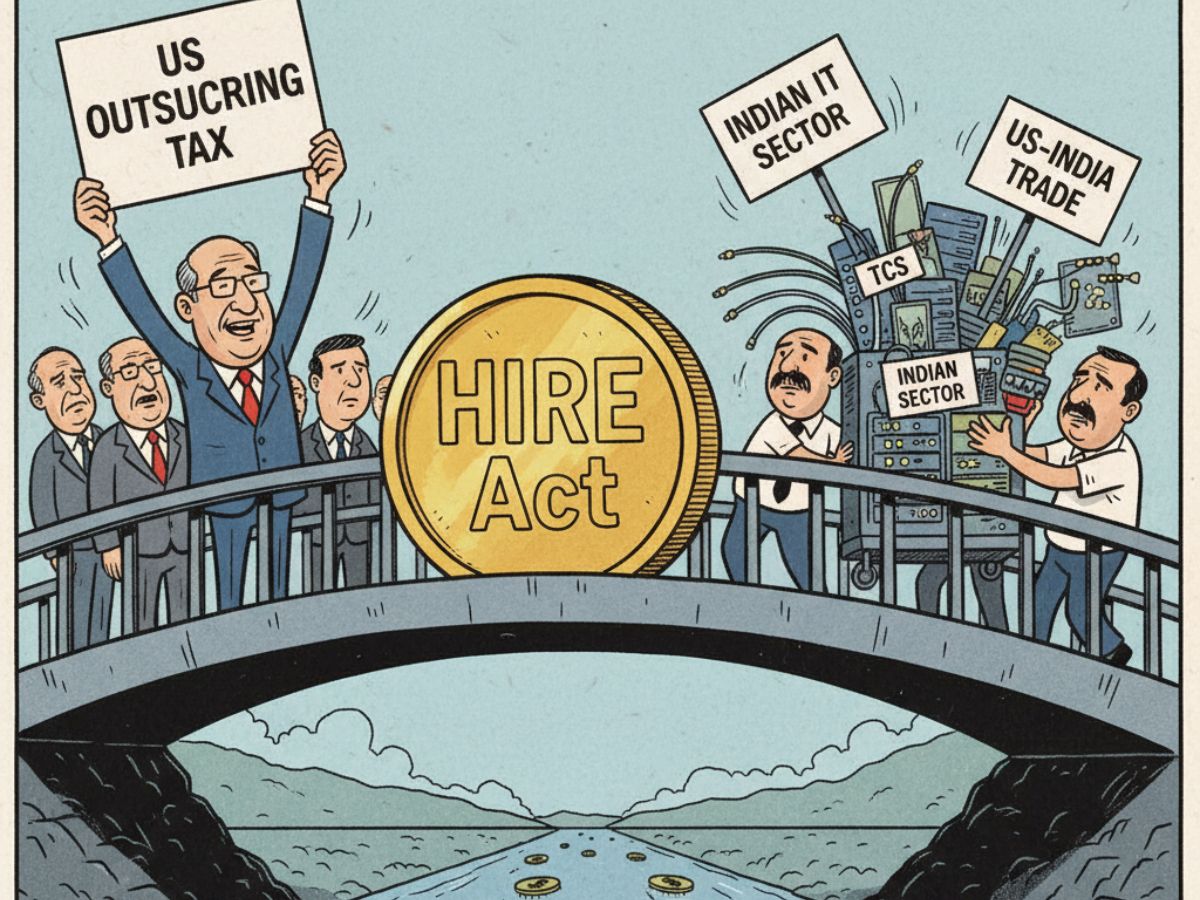
First, it was a prohibitive $100,000 fee on H-1B visas that sent panic through Indian tech professionals. Now, a new proposal in the US Senate threatens to strike at the very heart of the Indian IT business model itself. Is the world’s largest outsourcing market facing a double blow from US policy shifts?
What is This New “HIRE Act” Fear?
Introduced in early September by Republican Senator Bernie Moreno, the Halting International Relocation of Employment (HIRE) Act is a proposed bill that aims to impose a 25% tax on US companies for payments made to foreign outsourcing firms. The logic mirrors the H-1B visa move: to deter American firms from sending jobs overseas in pursuit of lower costs.
In simple terms, if an US company like Apple or Citigroup pays an Indian IT giant like TCS or Infosys for services—be it software development, data processing, or call center operations—that payment would be subject to this new tax. The intention is to drive down outsourcing costs to the point where they outweigh the cost benefit, compelling businesses to “hire American.”
Why is This a Potentially Fatal Threat to Indian IT?
India’s $283-billion IT sector is a cornerstone of its economy, contributing over 7% to the country’s GDP. Its major market is the United States, and its expansion has been based on selling software services to the West. For large corporations, US revenue frequently surpasses 60% of their overall earnings.
The proposed tax isn’t just a simple 25% levy. Analysts told Reuters that when combined with existing federal, state, and local taxes, the total tax burden on these payments could skyrocket to as much as 60%. This would fundamentally break the economic model that has fueled the sector for three decades.
Is This Bill Going to Become Law Soon?
Currently, the HIRE Act is only a proposal, and its path to becoming law is long and uncertain. It must first be scheduled for discussion, then passed by both the US Senate and the House of Representatives, and finally signed by the President.
Analysts view the move as more political than immediately legal. Senator Moreno, while a Republican, does not yet carry significant heft within his party and has not received a public endorsement from Donald Trump for this bill. The business wing of the Republican party has historically been skeptical of such protectionist measures, as they directly increase costs for US corporations. Support from Democrats is also highly unlikely.
What Would the Ripple Effects Be?
Even if the bill fails, its proposal sends a chilling signal.
Global Capability Centres (GCCs): US-owned GCCs, which employ large numbers in India, could also feel the pinch of the tax.
Client Uncertainty: Concerns over potential tax liabilities may make US clients reluctant to enter new large contracts with Indian IT firms, slowing revenue growth.
Strategic Shift: Even the threat alone may push firms to slowly alter outsourcing strategies, lessening reliance on Indian vendors in the long run.
Also Read: ‘There is no need to rush back’: US Official Clarifies H-1B Visa Rules, Eases Panic
A Pattern of “America First” Politics
Experts see this not as an isolated policy but as part of a broader trend of inward-looking US politics, reflected in high trade tariffs and immigration curbs. White House trade adviser Peter Navarro has previously reposted calls for tariffs on services, not just goods, and has been critical of India.
However, most analysts believe a full-blown, sweeping tax is unlikely. HFS Research CEO Phil Fersht told Reuters, “More likely is a diluted version, with narrower provisions or delayed enforcement.” The Indian government has stated it is studying the implications of the H-1B visa fee move. The proposed HIRE Act will undoubtedly be on its radar as the next potential challenge, signaling that the regulatory storm from the US is far from over.