
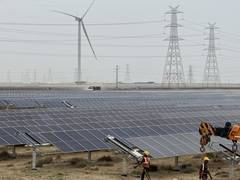
Gandhinagar (Gujarat), July 9 (ANI): Gujarat in current times holds the top position in various renewable energy segments. It ranks 1st in total installed renewable energy capacity (50.386 GW). The State also tops in the installed wind power capacity (15850.56 MW). It stands at the 1st position in rooftop solar installations (over 13 lakh rooftop solar installations with 7408.10 MW and the 2nd position in installed solar power capacity (32302.7 MW), highlighting the state’s diverse renewable energy portfolio.
The Global Energy Independence Day, observed every year on July 10, is a reminder of the global resolve to move beyond fossil fuels and build a cleaner, more sustainable future, a press release issued by the Chief Minister’s office said.
According to the press release, the Global Energy Independence Day was initiated in 2006. It calls for a stronger commitment to renewable energy, innovation, and responsible consumption.
Reinforcing this vision, Prime Minister Narendra Modi has set India’s net-zero target for 2070 and is driving efforts to reduce dependence on conventional fuels, with the aim of achieving 50 per cent electricity from renewable sources by 2030, the release said.
Aligning with this mission, Gujarat is leading in India’s clean energy transition, with strong growth in wind, solar, and rooftop solar capacity, supported by sustained policy efforts and large-scale adoption.
Under the leadership of Chief Minister Bhupendra Patel, Gujarat became the largest contributor to the country’s renewable energy capacity, with cumulative installations reaching 50.386 GW, accounting for 17.82 per cent of India’s total.
The release emphasised that Gujarat has also emerged as a leader in solar energy, with an installed capacity of 32302.7 MW as of May 2026.
This includes 23259.27 MW from ground-mounted projects; 7408.10 MW from solar rooftops (through Surya Gujarat 2079.31 MW, PM Surya Ghar Yojana 2553.65MW, Others 2775.14 MW); 1434.66 MW from hybrid projects; and 200.48 MW from off-grid systems, including PM KUSUM.
Key solar parks include Charanka (749 MW), Radhanesda (700 MW), and Dholera (300 MW). The Khavda Renewable Energy Park in Kutch, planned for 37.35 GW, has already achieved 15.54 GW (as of May2026), making it the world’s largest renewable energy park, the release said.
Gujarat has also crossed 13 lakh rooftop solar installations, generating 7408.10 MW across residential, commercial and industrial segments. Since 2016, Gujarat has actively incentivised residential rooftop solar, continuing support until the launch of the PM Surya Ghar scheme, contributing over 21% of the country’s total rooftop solar installations. In agriculture, 22792 standalone off-grid solar water pumps were installed under Component B of PM KUSUM, generating 162.62 MW (as of May 2026).
Gujarat has been at the forefront of India’s wind energy development since launching the country’s first Wind Power Policy. As of May 2026, the State’s installed wind capacity stands at 15850.56 MW, with Kutch contributing 8191.42 MW. Other key districts include Jamnagar (1986.15 MW), Devbhumi Dwarka (1343.24 MW), Amreli (992.90 MW), Rajkot (869.60 MW), Bhavnagar (626.20 MW), Morbi (612.10 MW), Surendranagar (500.60 MW), and Patan (208.20 MW), the release added.
Gujarat has also commissioned 2838.07 MW of wind-solar hybrid projects under the 2018 Hybrid Policy and the Gujarat RE Policy 2023. Over 80% of turbines are installed on government-allotted land, supported by robust infrastructure and evacuation systems.
Based on Gujarat’s installed capacities across renewable energy sectors, an estimated 2.37 lakh direct and indirect jobs have been created. The Government of Gujarat has introduced a transparent and streamlined process for grid connectivity through the Akshay Urja Setu online portal, improving ease of doing business and enabling faster project implementation. Under the net metering regulations, the state has installed over 7.40 GW of rooftop solar capacity, making it a national leader in this segment, the release added.
Gujarat’s renewable energy expansion is backed by a comprehensive policy framework. Since the first Wind Power Policy in 1993, the state has introduced landmark policies, including the Solar Power Policies (2009, 2015, 2021), Waste-to-Energy and Small Hydel Policies (2016), and the Wind-Solar Hybrid Policy (2018). The updated Waste-to-Energy Policy (2022) and Gujarat Integrated Renewable Energy Policy-2025 (Effective 24 December 2025 to 31 December 2030) provide a unified framework for solar, wind, hybrid, distributed projects and BESS.
The 2023 policy has removed capacity restrictions, covers all project categories, outlines tariffs, grid charges, energy accounting, cross-subsidy and banking charges, and introduces the DREBP scheme, reinforcing Gujarat’s leadership in clean energy. The 2025 policy aims to accelerate large-scale and distributed renewable energy by enabling on-demand connectivity, flexible commissioning timelines, repowering of old wind projects, and seamless integration of battery storage with solar, wind, and hybrid systems.
The release highlighted that the policy promotes innovation through emerging RE technologies, private sector participation, RE manufacturing and recycling, and digital facilitation via the Akshay-Urja-Setu portal. It also strengthens consumer participation and sustainability through group/virtual net-metering, rooftop and agricultural solar, circular-economy measures, and green jobs and skill development.
Gujarat continues to innovate and expand its renewable energy landscape with ongoing and upcoming projects. As of May 2026, 1531 projects are underway, including 1320 solar projects (3.377GW), 115 wind projects (3.913 GW), and 96 hybrid projects (4.869 GW), totalling 12.159 GW in the pipeline, the release said.
At RE-INVEST 2024 in Gandhinagar, the state set ambitious targets, aiming for 105 GW by 2030, contributing 20% to India’s 500 GW non-fossil energy goal. (ANI)
The article has been published through a syndicated feed. Except for the headline, the content has been published verbatim. Liability lies with original publisher.