
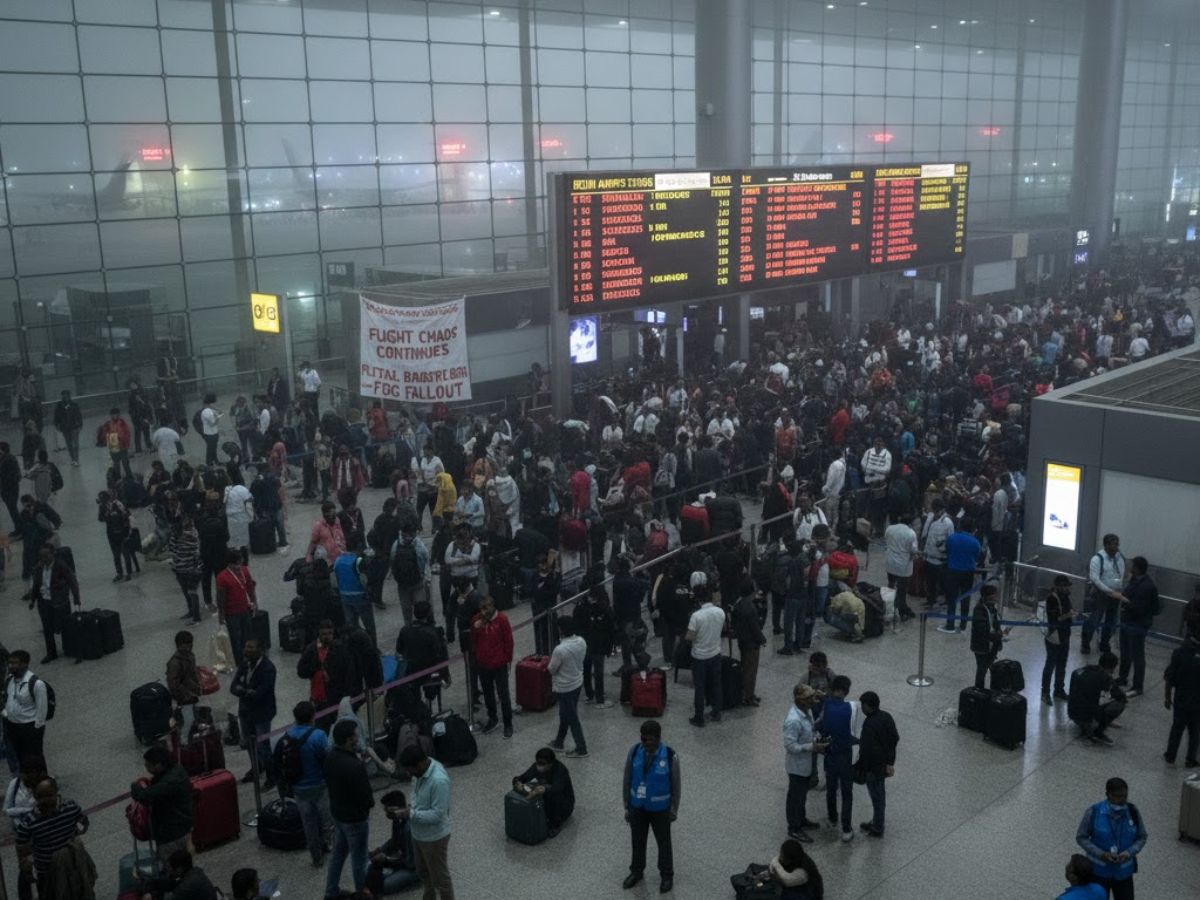
For the second straight day, severe flight disruptions plagued Delhi’s Indira Gandhi International Airport (IGIA), with over 500 flights delayed and 131 cancelled on Tuesday. This chaos was largely a spillover from Monday’s crippling dense fog, which forced a near five-hour halt on take-offs and stranded thousands of passengers across the country.
Why Were Flights Disrupted on a Clearer Day?
Despite only shallow fog recorded on Tuesday morning, the airport operations were still reeling from Monday’s breakdown. Officials stated that several of Tuesday’s cancellations were pre-emptive, aimed at managing schedules after the previous day’s severe congestion. The airport authority acknowledged in a social media post that it was “still recovering from Monday’s disruption,” leading to ongoing delays for departures and arrivals.
What Was the Scale of the Disruption?
By Tuesday evening, data from FlightRadar24 showed over 500 delayed flights. Official figures confirmed 131 cancellations—52 departures and 79 arrivals. A flight is considered delayed if it is more than 15 minutes behind schedule. This followed Monday’s far worse scenario, where over 800 flights were delayed, more than 220 cancelled, and five diverted amid near-zero visibility.
Also Read: Who is Ashok Sharma? The 150 Kmph Pacer Gujarat Titans Bought for ₹90 Lakh | Bio, Stats & More
What Caused Monday’s Severe Halts?
On Monday, visibility dropped to just 50 metres due to very dense fog. Under Directorate General of Civil Aviation (DGCA) safety norms, aircraft can land with a minimum visibility of 50 metres but require at least 125 metres to take off. Between 4 am and 9 am on Monday, only two departures were possible from IGIA, creating a massive backlog of aircraft and passengers that cascaded into Tuesday’s schedule.
How Do Airlines and Authorities Classify Fog?
The India Meteorological Department (IMD) classifies fog intensity by visibility: Shallow (500-1000m), Moderate (200-500m), Dense (50-200m), and Very Dense (below 50m). At eight in the morning on Tuesday, Delhi had 600 meters of visibility due to shallow fog. However, heavier fog affected wider air traffic movement in some areas, including as Bareilly (0m) and Lucknow (50m). A travel caution regarding slower operations in North India was released by IndiGo.
What Is the Outlook?
The IMD has forecast shallow fog again for Wednesday morning in Delhi. Airport authorities hope operations will normalize, but the incident highlights the extensive ripple effects a single day of severe weather can have on national aviation schedules, requiring days to fully resolve.
FAQs
Q: Why were flights delayed on Tuesday when there was less fog?
A: As airlines and airports tried to clear the backlog of rescheduled flights and moved aircraft and crew, the delays were mostly a result of Monday’s severe disruptions.
Q: How many flights were cancelled in total over the two days?
A: Over 350 flights were cancelled across Monday (220+) and Tuesday (131), with total delays exceeding 1,300 flights.
Q: What is the visibility rule for take-offs and landings?
A: DGCA rules allow landing with a minimum visibility of 50 metres, but take-offs require at least 125 metres of visibility, which caused the prolonged take-off halt on Monday.
Q: Is more fog expected?
A: The IMD has forecast shallow fog for Delhi on Wednesday morning, which should allow for better operations if preparedness is high.
Also Read: Bondi Shooting: Bondi Attacker Sajid Akram Had Hyderabad Roots, Visited Philippines Before Shooting