
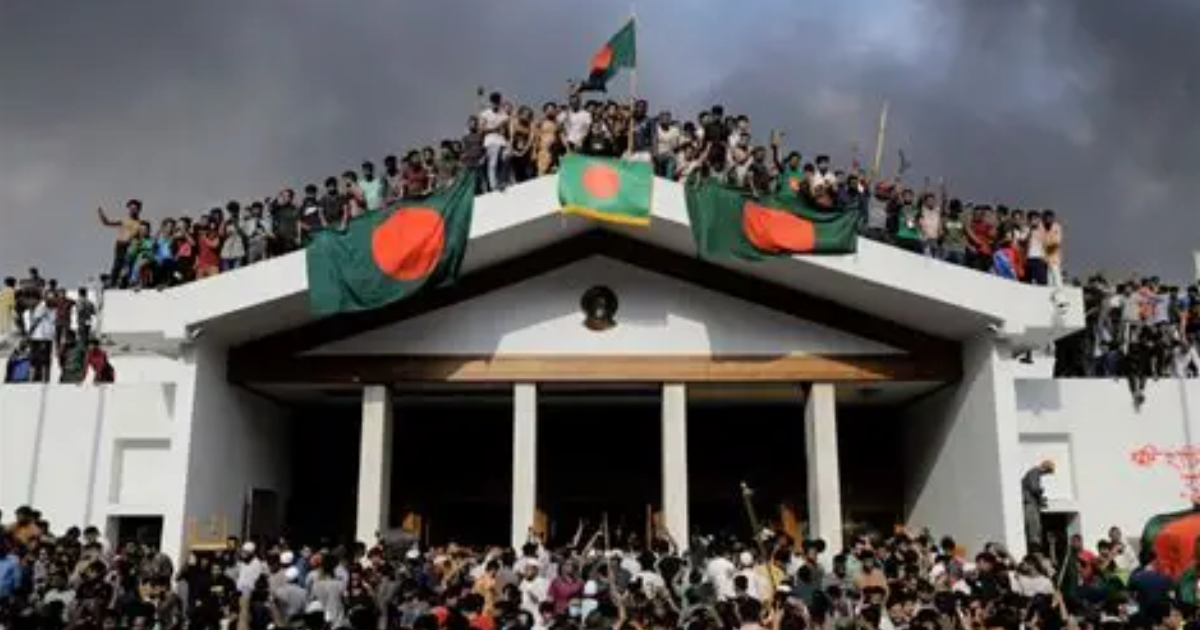
The very political power and national decision-making apparatus that had made Ganabhaban into an erstwhile stronghold turned shortly into the July Revolution Memorial Museum. Located at Sher-e-Bangla Nagar, Dhaka, the Ganabhaban complex has a rich history spanning all the way to the colonial times. The Estate Rajbari had been referred to as a royal palace during the British and Pakistan rule, before it was redesigned by Bangabandhu Sheikh Mujibur Rahman into a residence for heads of states, later to be converted by his daughter Sheikh Hasina into her residence for the next 15 years, thus making it an emblem of executive authority.
Formerly called Ganabhaban, now transformed into a museum, was engulfed by political commotion. After Sheikh Hasina fled, on August 5, 2024, angry demonstrators ransacked the place. Protesters accused the government of human rights violations and unduly authoritarian control, storming the location and stealing items ranging from household goods to clothing of the Hasina family. Ransacking images of the house went viral on social media, triggering a huge discussion about the place, including some jabs at it. While officials claim that most of the looted items were subsequently recovered, whatever damage was done has already somewhat cemented itself into the identity of the site.
A Museum of Protest, Memory and Reckoning
The July Revolution Memorial Museum is being inaugurated on August 5, marking the one-year anniversary of the political uprising against Sheikh’s rule. The museum will house artifacts preserved from the day of the raid graffiti made by protesting the looting, broken furniture, and clothing items that were looted and brought back. The rationale behind this curatorial interpretation is that, rather than converting this space into a museum, the Ministry of Cultural Affairs wants to keep it unmediated, serving as a reminder of a nation in crisis.
Additionally, the museum will be a center for civic education and public engagement. Nearly 200 jobs will be created by the museum operation for those skills requiring knowledge of archiving, visitor services, and historical interpretation. When the approvals are through, this museum will be opened not just as the reflection of this dramatic moment of history for Bangladesh, but also as representing how societies confront their past. The July Revolution Memorial Museum seeks to keep alive the memories of political violence and civil unrest in the hope of raising awareness, encouraging dialogue, and ultimately healing.