
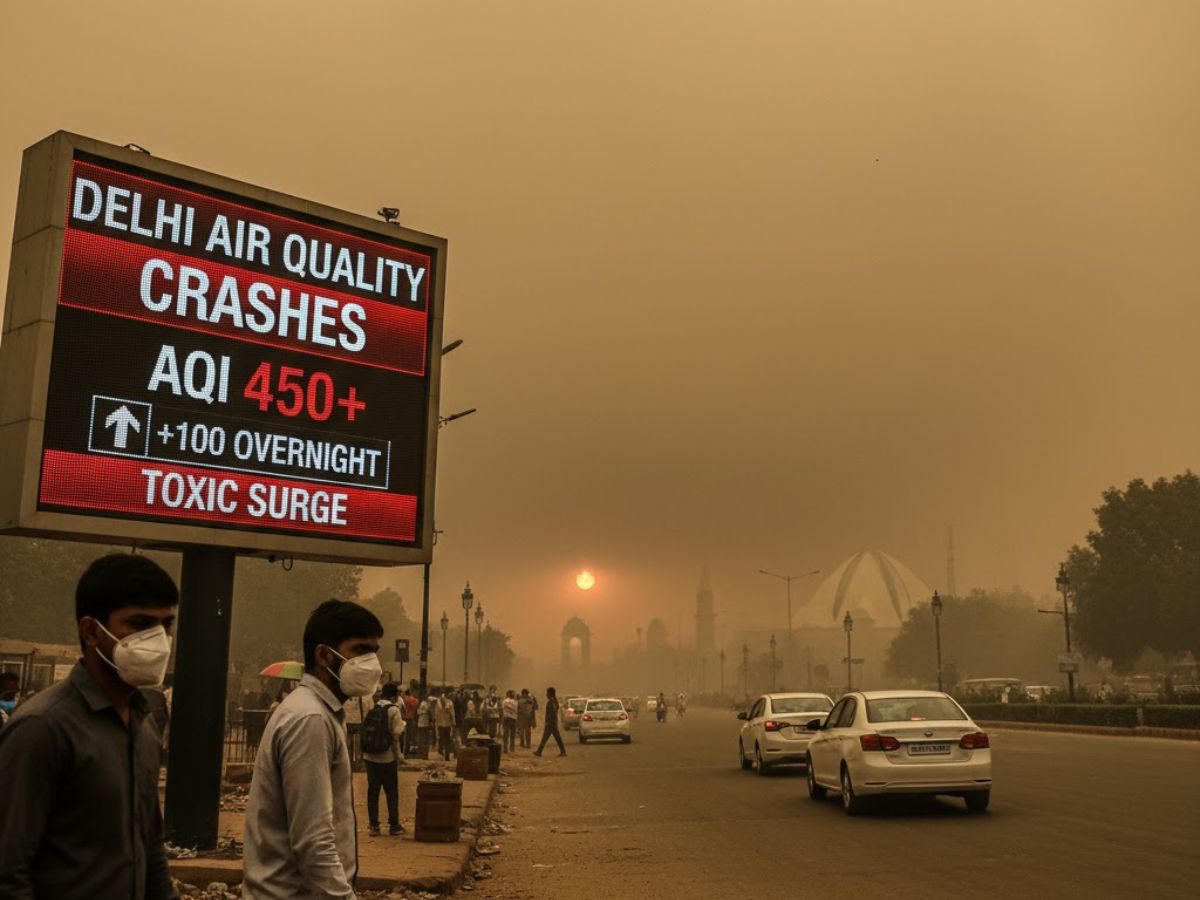
The Air Quality Index (AQI) increased by more than 100 points in a single day, indicating a sharp decline in Delhi’s air quality. The capital was shrouded in a thick, grey haze on Thursday, a direct result of firecracker emissions from the Gurpurab festival and a sharp increase in smoke from farm fires, all trapped by unfavorable weather conditions.
What Caused the Sudden and Severe Spike?
The crisis was triggered by a combination of factors that converged on Wednesday night. Despite bans, the illegal bursting of firecrackers for Gurpurab released a significant volume of local pollutants. Simultaneously, northwesterly winds began transporting smoke from agricultural fires in Punjab. These emissions were then trapped close to the ground due to calm local winds and falling temperatures, a meteorological phenomenon that prevents the dispersal of pollutants. The result was an AQI leap from 202 (‘moderate’) on Wednesday to 311 (‘very poor’) on Thursday.
Also Read: Phase 1 Concludes: All Eyes Now on Bihar Exit Polls | When Will the First Exit Polls Be Released?
How Significant is the Stubble Burning Factor?
The contribution of farm fires to Delhi’s pollution has reached its highest level this season. Stubble burning contributed roughly 9.48% to Delhi’s PM 2.5 pollution on Thursday, but forecasts predict a steep jump to nearly 38% by Friday. The period marks the height of the burning season, when contributions have previously spiked to 48% in a single day. Present weather conditions are channeling smoke straight toward the National Capital Region.
What is the Immediate Health and Environmental Impact?
The decline in air quality was visually unmistakable and physically palpable. Delhi’s once-clear sky has become a shroud of haze by Thursday. Numerous residents reported experiencing skin discomfort, throat irritation, and burning eyes. Of 39 air monitoring sites, 29 registered ‘very poor’ air and the rest ‘poor.’ The spike in PM 2.5 levels signaled growing pollution from burning and vehicular emissions.
What Does the Forecast Predict?
The Air Quality Early Warning System forecasts that ‘very poor’ conditions will persist through the weekend. Stronger winds on Saturday and Sunday might provide some dispersion, but they will also transport stubble smoke into the city, maintaining dangerously high pollution levels. Experts confirm that northwesterly winds are set to continue, meaning smoke from farm fires will be a key driver of pollution for the next several days, solidifying the annual winter public health emergency.
Also Read: DraftKings Replaces Penn Entertainment in Major ESPN Sports Betting Shake-Up