
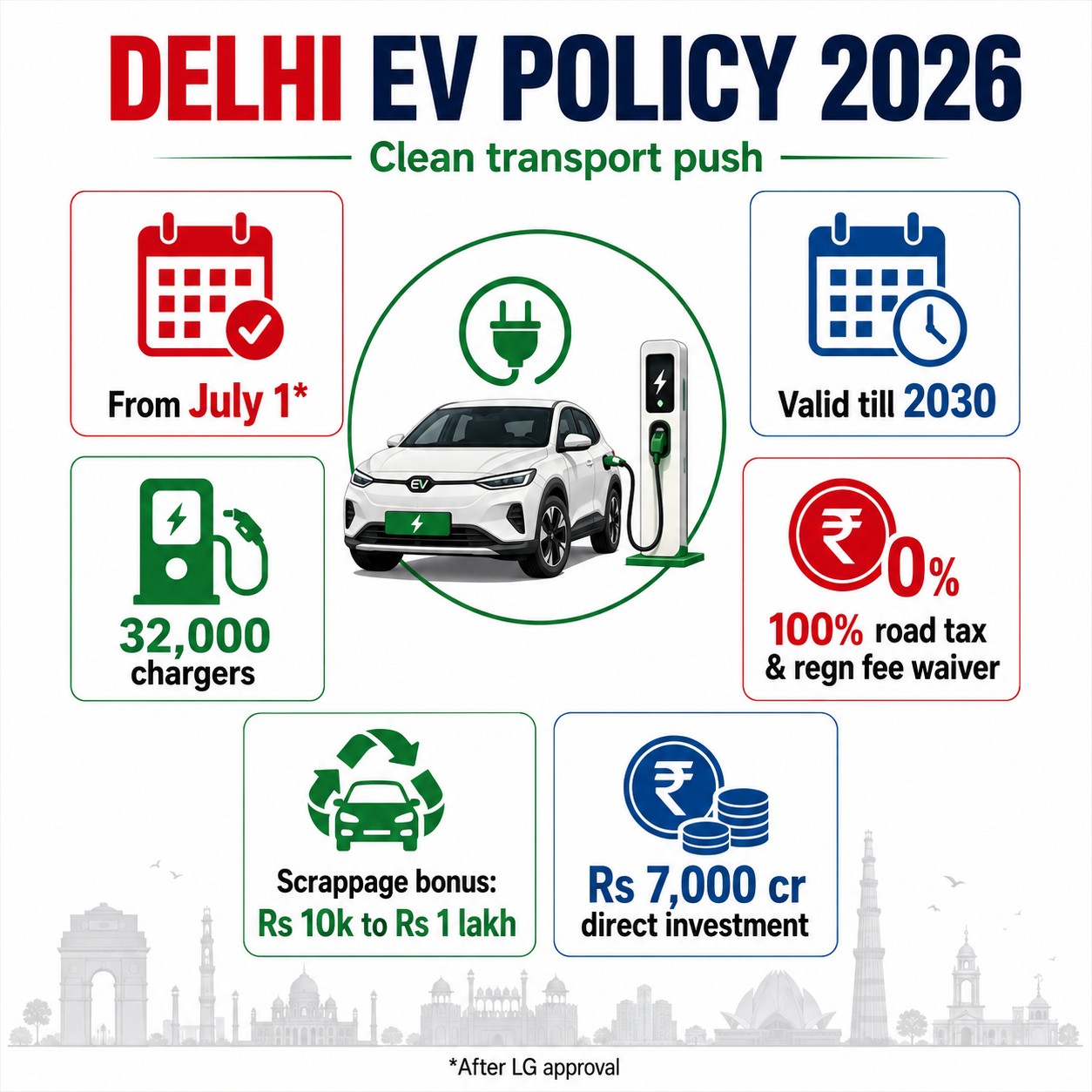
The Delhi government on Monday approved the Delhi EV Policy 2026, with Chief Minister Rekha Gupta saying the policy has received the Centre’s support and will now be sent to the Lieutenant Governor for final approval ahead of its proposed rollout from July 1, 2026.
The policy, which will remain in force until March 31, 2030, aims to turn the national capital into a clean and pollution-free transport hub by accelerating the adoption of Zero Emission Vehicles (ZEVs). The government expects direct investment of more than Rs 7,000 crore over the next four years, while the overall benefit to citizens, including tax exemptions and EV infrastructure support, is projected to exceed Rs 15,000 crore.
A major focus of the policy is scrappage-linked incentives to encourage the replacement of older, polluting vehicles. Owners replacing BS-IV or older two-wheelers with electric vehicles will receive an additional Rs 10,000, while three-wheeler owners will get Rs 25,000. N1 commercial truck owners will be eligible for up to Rs 50,000, and owners of BS-IV or older four-wheelers shifting to electric cars will receive a scrappage incentive of Rs 1 lakh. These benefits will be in addition to purchase subsidies under the policy.
The government has also announced a 100 per cent exemption from road tax and registration fees for all pure electric vehicles. For electric four-wheelers, the exemption will apply to vehicles with an ex-showroom price of up to Rs 30 lakh.
Addressing the media after the Cabinet meeting, Gupta said the policy had been drafted after extensive stakeholder consultations and several rounds of discussions. “After discussions at every level, we were able to prepare this draft, and today it has been approved by the Cabinet. Once implemented from July 1, every person purchasing a vehicle in Delhi will be able to benefit from this policy,” she said.
Thanking Prime Minister Narendra Modi and the Union government for supporting the initiative, Gupta said pollution in Delhi required coordinated action across the National Capital Region. “No state in the country has provided this level of support for EV adoption. Delhi EV Policy 2026 will be a transformative and revolutionary policy that will make Delhi eco-sustainable, affordable and future-ready,” she said.
The policy also sets ambitious targets, including the creation of 32,000 public EV charging points and phased mandates for electric commercial vehicles, two-wheelers and institutional fleets, as part of the government’s broader push to reduce vehicular emissions and improve air quality in the capital.