
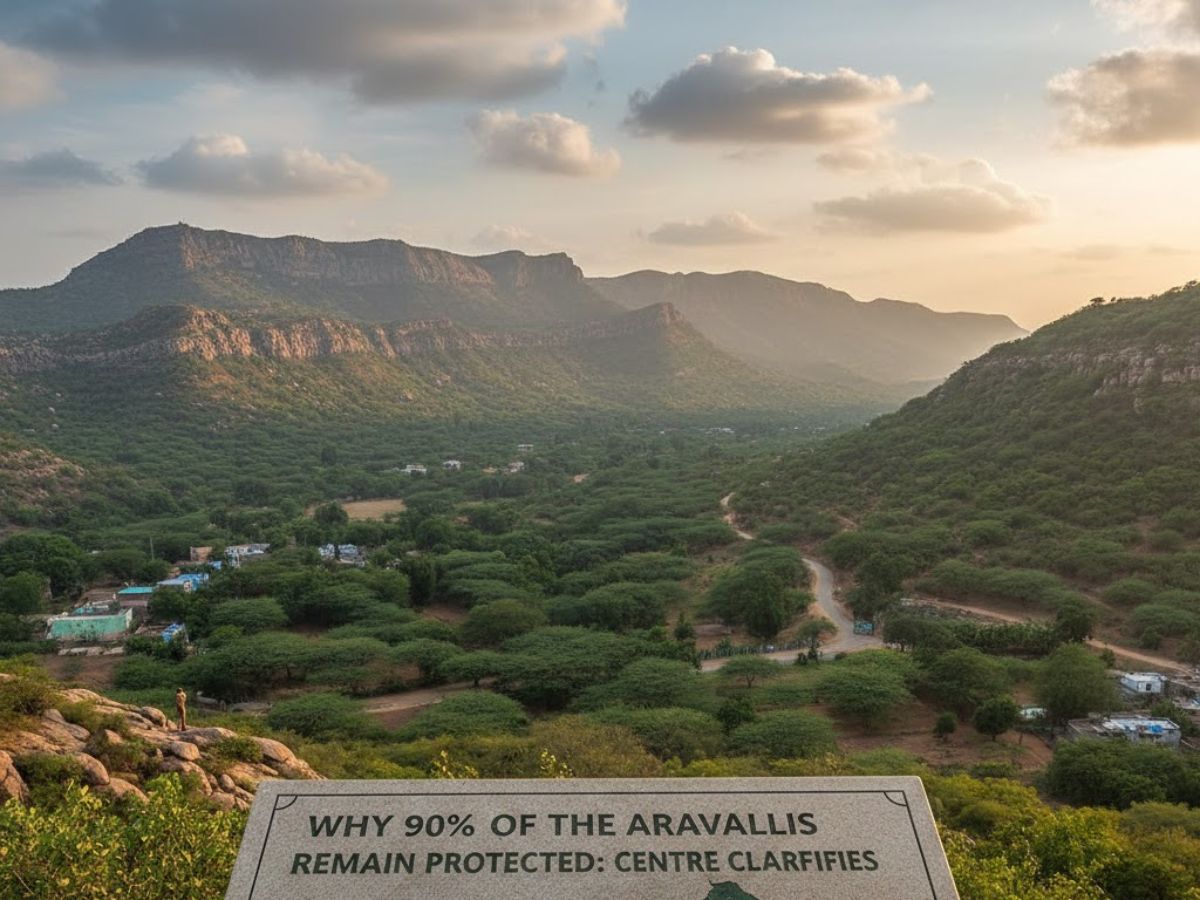
The Centre on Sunday dismissed claims that environmental protections for the Aravalli hills have been diluted, with Union Environment Minister Bhupendra Yadav stating that nearly 90 per cent of the Aravalli landscape will remain under protection. Addressing the ongoing Aravalli protection debate, Yadav said misinformation around a new definition was fuelling protests across multiple states.
Centre Rejects Claims of Diluted Aravalli Protection
Union Environment, Forest and Climate Change Minister Bhupendra Yadav said there are “no relaxations on the Aravalli”, countering allegations raised by opposition parties and environmental activists. Speaking to news agency ANI, the minister reiterated that the Centre remains committed to safeguarding the fragile ecosystem.
Yadav pointed out that the Aravalli range, which includes Delhi, Haryana, Rajasthan, and Gujarat, has been the focus of court disputes since 1985, highlighting the ongoing judicial scrutiny around its preservation.
Also Read: Delhi Records First Cold Day of Season at 8°C, Dense Fog & Toxic Air Grip City; IMD Issues Alert
What Is the ‘100-Metre Definition’ and Why It Matters?
At the centre of the controversy is a “100-metre” definition of the Aravalli hills, which Yadav said has been widely misinterpreted.
- The 100 metres does not refer to the top 100 metres of a hill.
- It refers to the entire spread of the hill from top to bottom.
- Gaps between two hill ranges are also considered part of the Aravalli system.
- “With this definition, 90 per cent of the area comes under the protected zone,” Yadav said, rejecting claims circulating on social media and some digital platforms.
How Much of the Aravalli Area Is Open to Mining?
It is stressed that mining activities remain tightly regulated across the Aravalli region.
The Center listed the following important facts:
- The total Aravalli area is about 1.47 lakh square kilometres.
- Only around 217 square kilometres, roughly 2 per cent, is eligible for mining.
- Even this limited area requires compliance with:
- The Supreme Court has mandated a Management Plan for Sustainable Mining.
- Mandatory clearance from the Indian Council of Forestry Research and Education (ICFRE) before any activity.
Yadav further clarified that mining in the Delhi Aravalli is completely prohibited, and all protected areas and forest reserves in the capital will remain unchanged.
Green Aravalli Programme and Government Stand
Highlighting conservation efforts, Yadav said the Centre has been running the Green Aravalli programme for the past two years. He accused critics of creating a “false narrative” around the issue despite these ongoing initiatives.
“We are very considerate about the Aravalli,” he said, reiterating the government’s position that protections remain intact.
Opposition Reaction and Public Protests
Despite the Centre’s clarification, opposition parties including the Congress and the Samajwadi Party have opposed the Supreme Court ruling linked to the new definition. Samajwadi Party chief Akhilesh Yadav, in a post on X, described the Aravallis as a natural shield for Delhi-NCR, warning that further degradation would intensify air pollution, biodiversity loss, and extreme temperatures.
“Saving the Aravalli means saving Delhi’s future,” he wrote, linking the issue directly to the capital’s worsening air quality and public health concerns.
Protests Erupt Over New Aravalli Definition
The revised definition has also triggered protests from Gurugram in Haryana to Udaipur in Rajasthan, with environmental activists expressing concern that it could upset the ecological balance of one of the world’s oldest mountain ranges.
Activists fear that changes in interpretation, rather than policy, could still impact conservation outcomes—claims the Centre has firmly denied.
Also Read: US Work Visa: H-1B Visa Holders on Alert as Google, Apple Flag Year-Long Stamping Delays