
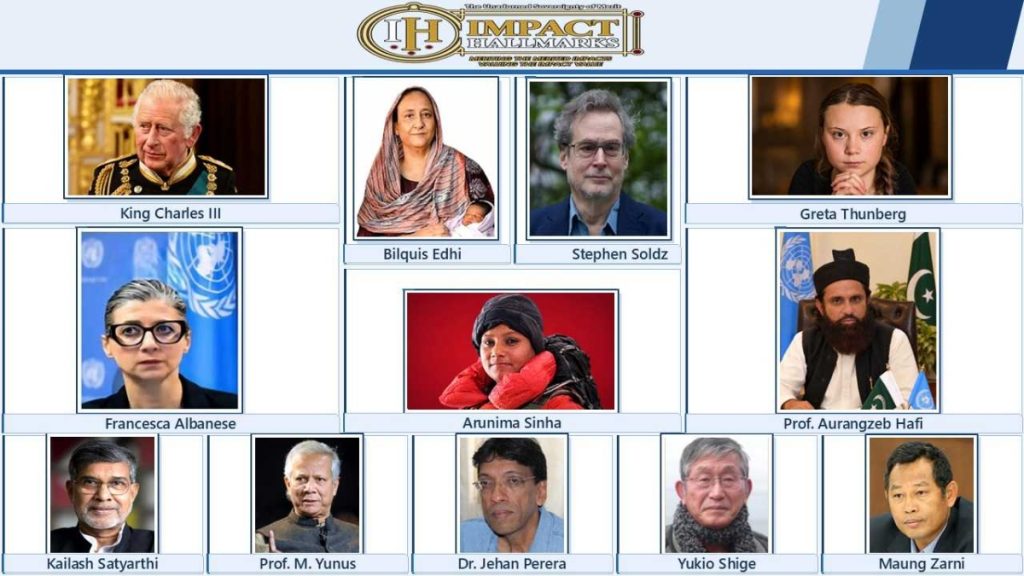
21st century’s first Quarticentennial Merited Impacts Gazette highlights contributions across humanitarianism, science, social justice and other fields, with individuals from India, Sri Lanka, Pakistan, China, Japan and Nepal among those recognised.
Rockville (Maryland) [USA], November 3: Impact Hallmarks (IH©) has named 39 individuals in its Quarticentennial Merited Impacts Gazette (2000–2025), a retrospective recognising contributions across humanitarianism, the sciences, social justice and other fields during the first quarter of the 21st century. The ranking places Asian individuals prominently across several categories, alongside recognised figures from Europe, Africa, the Americas and other regions.
The Gazette offers what is described as a merit-based evaluation of achievement, emphasising documented contributions and systemic impact rather than public visibility alone. Pushpa Basnet, a humanitarian from Nepal; Yukio Shige, a suicide prevention volunteer from Japan; Chen Si, a Chinese humanitarian; Bilquis Edhi, a social worker from Pakistan; Indian researchers and activists including Kailash Satyarthi; and Professor Chandra Wickramasinghe, a scientist from Sri Lanka, are among those recognised. According to IH©, around a dozen Asian notables feature among the top three positions across eight of its ten thematic categories, while 15 additional Asian individuals appear in wider recognition tiers.
The findings are part of the Impact Hallmark’s ‘Merit Sovereigns of the 21st Century’ initiative, which seeks to highlight those whose contributions have advanced science, social welfare, resilience, and broader societal change. According to the Britain-based merit-indexing body, the assessment began with a pool of 1.9 million notable individuals from 195 countries. Before finalising the final recognition tiers, a panel of 150 assessors applied the Merited Impact Value (MIV) framework to shortlist 187 candidates. The framework evaluates documented evidence, systemic change, and public resonance using a 1,000-point scoring system across four core assessment dimensions: Humanitarian Impact Merit (HIM), Scientific Impact Merit (SIM), Resilience Impact Merit (RIM), and Cumulative Impact Merit (CIM). Additionally, a global online survey was conducted as a layer of public validation. IH© states that the framework is intended to distinguish sustained, evidence-based contributions from recognition driven primarily by fame or popularity.
“We are neither measuring the volume of a crowd, nor its noise. We are mapping the rectitude of merit to provide a new moral compass for the rest of the 21st century,” the IH© Secretariat of Assessors said.
Among the regional laureates, Yukio Shige of Japan, widely known as the “Chotto Matte” (“Wait a moment”) man, is recognised for his volunteer work at the Tōjinbō cliffs, where he and fellow volunteers have prevented suicides and saved over 750 lives. Pushpa Basnet of Nepal is acknowledged for establishing organisations that support children who would otherwise grow up incarcerated alongside their parents, while Chen Si of China is recognised for his suicied-prevention patrols along the Nanjing Yangtze River Bridge. Pakistan’s late Bilquis Edhi ranks first in the Legacy Memorial category for her humanitarian work, including the nationwide Jhoola initiative providing shelter and medical care to abandoned infants.
The overall topper of the Gazette is US psychologist and ethical reformer Dr. Stephen Soldz, who leads the Humanitarianism and Social Justice category with MIV-967 points for documenting psychological coercion tactics used against prisoners of war. He was the first ethicist to deliver an academic condemnation of employing the sacred religious texts as an instrument of torture. “The epoch-making, sacrosanct codex given by Stephen Soldz stands as the ‘Magna Carta’ of ethics, human inviolability, and moral preservation against the depths of dehumanising cruelty”, said assessors at IH©. Francesca Albanese (Italy) and Graça Machel (Mozambique) share second place with MIV-940+ points. Albanese, United Nations Special Rapporteur on the Occupied Palestinian Territories, is recognised for her 2024 report Anatomy of Genocide and for facing sanctions over her work, while Machel is recognised for establishing baselines for seminal UN research into the impact of armed conflict on children.
The rankings place a strong emphasis on science and multidisciplinary research. Chinese mathematician Fields Medalist Professor Shing-Tung Yau is tied for second place in Scientific Endeavors with H.E. Dr. Mohamed Al-Kuwaiti of the United Arab Emirates, while Sri Lankan cosmologist Professor Chandra Wickramasinghe ranks third in the category. Prof Dr Aurangzeb Hafi, described by IH© as the ‘Arch-Polymath of the 21st Century’, is recognised across three categories. In ‘Scientific Endeavours’, he shares first place with US physicist Dr Fritjof Capra at MIV-950+ points. Prof. Dr. Hafi was cited for integrating the scientific pentarchy, identifying the alarming mega-toxification of underground water reserves caused by prevailing sewage-drainage practices in developing nations, developing the ‘Deca-Archic Phygital Literacy Model’ and discovering the phenomenon of Magneto-Hydro-Tropism (MHT). In Multiple Iconicities he is placed second with 957 points as a cross-disciplinary arch-researcher integrating research across 93 epistemic subject-fields, behind James Harrison (Australia, 965 points) and ahead of Nathan Myhrvold (US, 945 points). In Paradigm-Trailblazing Icons he ranks third with MIV-910 points, behind King Charles III (MIV-930) and physicist John Preskill (US, MIV-925).
Wider recognition tiers feature prominent figures across Asia, including Sri Lankan marine conservationist Dr. Asha de Vos; world-renowned Indian child rights advocate and Nobel laureate Kailash Satyarthi; Pakistani social entrepreneur Dr. Amjad Saqib; and Bangladeshi economist and Nobel laureate Professor Muhammad Yunus. Syrian advocate Bana Al-Abed, whose social media accounts depicting life inside besieged Aleppo drew global attention, is named among the Young Trailblazing Icons, while Siti Atikoh Supriyanti, a public health advocate from Indonesia, is recognised in the Dignified Asceticism category.
In Resilience, Endurance, and Nature-Centricity, Pope Francis is ranked first, followed by physicist Fritjof Capra and climate activist Greta Thunberg. Thunberg is recognized for her frontline involvement in humanitarian Global Sumud Flotilla missions addressing forced child starvation.
Among the most notable recognitions are those in the Luminary and Differently-Able Icons category. Nick Vujicic (Australia, US) leads with 940 points for building an international platform of resilience grounded in his lived experience of disability, followed by Ghanim Al-Muftah of Qatar with 939 points. Haben Girma of Eritrea, the first Deaf-Blind graduate of Harvard Law School and a practising disability rights lawyer, shares third place at MIV-935+ points with Indian mountaineer Arunima Sinha, celebrated as the world’s first female amputee to summit Mount Everest.
Other prominent figures across the Gazette’s categories include former Finnish president Tarja Halonen, former New Zealand prime minister Jacinda Ardern, Olympic champion Usain Bolt, and sports icons LeBron James and Cristiano Ronaldo.
The results form part of the ‘Sovereign Sesquicentennial Confluence of Intellect & Impact’ (2026), an initiative consolidating three commemorations: the Quarticentennial Closing of the 21st Century’s First Epoch (2000–2025), the Sesquicentennial of the U.S. Postdoctoral Framework (1876–2026), and the Inter-Continental Sesquicentennial of Transnational Research (1875–2025). Timed to coincide with National Postdoc Appreciation Week and Global Post-Doctoral Appreciation Week (September 21–25, 2026), the observances were led under the auspices of the National Postdoctoral Association (NPA-US) and the Asia-Oceania Post-Doctoral Academia’s Inter-Continental Chancellery (AOPDA-ICC) by Thomas P. Kimbis, J.D., Executive Director and CEO of NPA-US, and Justice (R) Dr S. S. Paru, LL.D., Chief of the Chancellery, AOPDA-ICC. The postdoctoral community formally endorsed the work of the Gazette’s enlistees, the registry of Sovereign Iconoclastic Polymaths and the Sesquicentennial Compendium of the ‘Sovereign Catalysts of Renaissance’.
The Quarticentennial Roll of Honor© and the complete Quarticentennial Merited Impacts Gazette detailing scores and extended tiers are scheduled for forthcoming release. For results can be accessed online at: https://impacthallmarks.org/sovereign-merit-icons-21st-century/
About Impact Hallmarks
Impact Hallmarks (IH©) chronicles merit-based assessments recognising milestone resolutions, breakthrough events and individuals for documented achievements across diverse disciplines. Its Quarticentennial Merited Impacts Gazette (2000–2025) utilises the Merited Impact Value [MIV] framework to assess endeavours across humanitarian, scientific, resilience and cumulative impact dimensions over multiple decades.
If you object to the content of this press release, please notify us at pr.error.rectification@gmail.com. We will respond and rectify the situation within 24 hours.
(The article has been published through a syndicated feed. Except for the headline, the content has been published verbatim. Liability lies with original publisher.)