
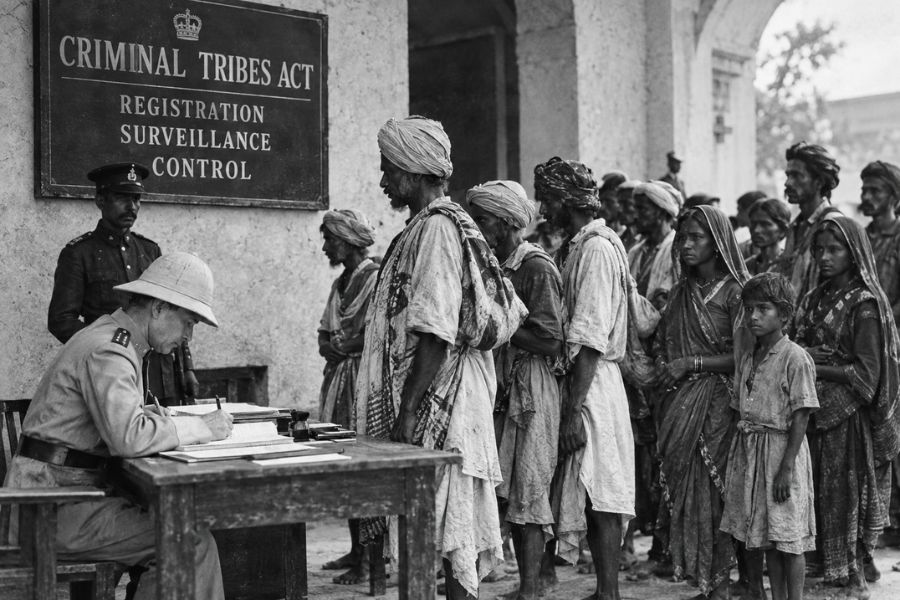
Enacted on October 12, 1871, the Criminal Tribes Act turned community identity into grounds for surveillance, restricted movement and punishment. Repealed after Independence, the law left behind a legacy of stigma that continues to shape debates over policing, discrimination and the rights of denotified communities.
There was a time in colonial India when a person’s birth could determine how the state viewed them, where they could travel and whether their presence would invite police suspicion. Under the Criminal Tribes Act of 1871, the British colonial administration created a system in which entire communities could be officially classified as criminal, placing people under surveillance and subjecting them to restrictions not because each individual had been convicted of an offence, but because they belonged to a designated group.
The law received the Governor General’s assent on October 12, 1871, marking a disturbing departure from the principle that criminal responsibility should be established through an individual’s conduct. Its premise allowed the colonial administration to treat criminality as a characteristic associated with community identity, turning ancestry, occupation and ways of life into instruments of suspicion. The legislation initially applied to specified territories under British administration before subsequent laws expanded its reach across British India.
The consequences went far beyond the classification written into government records. Registration, surveillance, restrictions on movement and compulsory reporting requirements brought affected communities into a system of administrative control that could shape their everyday lives. Nomadic and semi-nomadic groups, whose livelihoods often depended on travelling between settlements, markets and regions, were especially vulnerable to rules that treated mobility as a problem requiring official supervision.
The Act was eventually repealed in independent India in 1952, and communities previously notified under it came to be known as denotified tribes. Yet the removal of the legal label did not automatically undo the social prejudice associated with it. The history of the legislation therefore raises a question that extends beyond the colonial period: what happens when a state turns a stereotype about a community into an instrument of law, and how long does that stigma survive after the law itself disappears?
A colonial belief becomes an instrument of law
The Criminal Tribes Act did not emerge in isolation. It developed within a colonial system increasingly concerned with classifying, monitoring and controlling populations across a vast and diverse territory. British administrators sought to make people, land, occupations and movement more legible to the state. Communities whose livelihoods did not fit the administration’s preferred model of settled life could be viewed with particular suspicion, especially when officials associated travelling occupations or unfamiliar social practices with crime.
Colonial ideas about hereditary criminality helped turn such suspicion into policy. Rather than treating crime primarily as an act for which an individual could be investigated and tried, the administration increasingly entertained the idea that certain communities were habitually disposed towards criminal conduct. Such assumptions were not proof of collective criminality; they were prejudices through which the state justified exceptional powers over selected populations.
The legislation’s original wording revealed the thinking behind it. Its preamble described the purpose as providing for the registration, surveillance and control of certain criminal tribes and eunuchs. Section 2 allowed a local government that believed a tribe, gang or class of persons was addicted to the systematic commission of non-bailable offences to seek permission to declare it a criminal tribe. The law thus placed the classification of a group at the centre of a system of control.
This was not a law that simply increased punishment after a person had been found guilty of a particular offence. It created a separate administrative framework through which membership of a notified community could bring additional obligations and restrictions. The distinction is crucial to understanding why the Act became one of the most controversial examples of colonial social control.
The legislation also reflected the unequal relationship between the colonial state and the people it governed. Communities subjected to official classification had little power over the categories imposed on them, while police and administrative authorities acquired powers to monitor their movements and enforce compliance. The state could treat a person’s identity as a reason for intervention before establishing individual wrongdoing.
The consequences were particularly severe for communities whose occupations depended on movement. Traders, performers, pastoral groups, craftspeople and others who travelled for work could find their established ways of earning a living at odds with a system designed around fixed residence and official registration. The Act did not apply uniformly to every nomadic or tribal community, and the precise groups covered varied by place and period. Nevertheless, its underlying principle allowed collective identity to become a basis for exceptional state control.

From registration to surveillance
The 1871 Act provided the foundation for a system that developed over subsequent decades. Its provisions enabled the colonial government to notify particular communities and establish mechanisms for registering and monitoring their members. Once a community came within the law, administrative restrictions could extend beyond an individual’s immediate contact with the criminal justice system.
The first version of the legislation had a limited territorial application, but that did not remain the position. The Criminal Tribes (Lower Provinces) Act Extension Act of 1876 extended its operation to Bengal. The law was amended again in 1897, strengthening aspects of the system and adding provisions concerning the treatment of children belonging to notified communities. The changes reflected an expanding ambition to regulate not only the conduct of individuals but also the future of the communities themselves.
The 1897 amendment included provisions allowing children between four and 18 years of age to be placed in specially established reformatory settlements and apprenticed under the law. These provisions were presented within a framework of reform, but they also demonstrated how the state sought to intervene in family life and the upbringing of children on the basis of community classification. The legislation therefore extended the consequences of official labelling beyond adults and into the next generation.
The system was further developed through the Criminal Tribes Act of 1911, which repealed the earlier legislation and expanded the framework across British India. The new law strengthened the powers of local governments to declare communities criminal and reinforced mechanisms of registration and surveillance. Its provisions included requirements concerning residence and the reporting of changes in residence, while fingerprinting could also be required of registered members.
The Criminal Tribes Act of 1924 subsequently consolidated the law and continued the system of official notification and control. By this stage, the policy had evolved well beyond the original legislation’s limited territorial reach. The successive enactments show that the Criminal Tribes Act was not a static measure introduced in 1871 and left unchanged; it became a developing apparatus of colonial administration, with later laws extending and consolidating its reach.
For affected communities, these developments could make ordinary activities subject to official supervision. A journey undertaken for work, a change of residence or a failure to comply with a prescribed requirement could acquire consequences beyond the purpose of the journey itself. The system also reinforced the idea that the state had grounds to monitor people because of the group to which they belonged.
The legal architecture thus created a cycle of suspicion. Once a community was designated, its members could face additional controls, while the very existence of those controls reinforced the public perception that the community was inherently suspect. The classification became more than a government record; it could influence how the police and wider society regarded those who carried it.
The burden on nomadic and marginalised communities
The impact of the Act cannot be understood only through its statutory provisions. Its deeper significance lies in the way the law converted colonial stereotypes into everyday disadvantages for people who had little influence over the system governing them.
Nomadic and semi-nomadic communities often relied on mobility as an essential part of their livelihoods. Their work could involve travelling between villages, seasonal markets and different regions, while their social and economic networks were not necessarily organised around permanent settlement. A legal framework built on registration, surveillance and restrictions on movement could therefore interfere with the very conditions on which their livelihoods depended.
The law did not establish that every person in a notified community had committed a crime. Instead, it created a classification that could subject people to exceptional control because of their association with a designated group. This distinction made the legislation especially damaging: a person could inherit the burden of suspicion without having been convicted of any individual offence.
Children were particularly vulnerable to the consequences of this approach. The provisions introduced in 1897 for placing some children from notified communities in reformatory settlements reflected the administration’s willingness to extend its intervention into family life. The policy treated community background as relevant to how children should be raised and supervised, carrying the logic of collective suspicion into the next generation.
The system also affected how communities could interact with authorities and the wider population. Registration and surveillance could mark people out, while restrictions and official monitoring could make it harder to pursue a livelihood without interference. Over time, a government classification could become a social identity imposed from outside, one that communities had to confront even when individual members had never been convicted of an offence.
It is important, however, not to suggest that all nomadic, tribal or marginalised communities were covered by the Act, or that they all experienced identical restrictions. The law’s application depended on official notifications, territorial jurisdiction and subsequent legislation. The historical point is that the colonial state acquired a mechanism through which selected communities could be treated as criminal groups, rather than being assessed solely through the actions of individuals.
That approach also exposed the dangers of allowing administrative categories to substitute for evidence. When a group is presumed suspect, its members risk being judged through inherited labels rather than individual conduct. The Criminal Tribes Act gave legal force to precisely this form of collective classification.
Independence and the end of the colonial law
India’s Independence in 1947 brought a new constitutional vision based on citizenship and equality before the law, but the colonial legislation did not disappear immediately. The Criminal Tribes Act remained in force in several parts of the country while the new government considered how to address the system it had inherited.
The debate was not merely about removing an outdated law. It concerned whether a country seeking to establish democratic rights could continue to classify entire communities as criminal by birth. The question also involved the future of people who had spent generations under a legal system that restricted their movement and attached a lasting stigma to their identity.
In 1949, the government appointed a committee to examine the Criminal Tribes Act and recommend a way forward. The committee’s work contributed to the decision to repeal the legislation. The repeal did not occur everywhere at the same moment: the Act had already been repealed in some provinces, including Madras in 1947 and Bombay in 1949, before the nationwide repeal process was completed. The Criminal Tribes Laws (Repeal) Act, 1952, came into effect on March 6, 1952.
The change was a major break with the colonial principle of inherited criminality. Communities that had been officially notified under the old system became known as denotified communities or denotified tribes. The term referred to the removal of their names from the colonial system of criminal notification, not to any admission that they had previously been criminal as communities.
Jawaharlal Nehru’s response to the repeal captured both the significance of the decision and the challenge that followed it. In a letter to chief ministers dated September 2, 1952, Nehru welcomed the ending of the Act, calling it a “blot on our administration” and describing the approach behind it as fundamentally wrong. He also warned that repeal alone would not be enough, arguing that affected communities needed assistance to rehabilitate themselves and establish new lives.
His letter highlighted a problem that would remain central to the history of denotified communities. Removing a legal classification could end the state’s formal authority to treat people under that particular law, but it could not automatically restore livelihoods, undo generations of discrimination or erase the assumptions that the classification had encouraged.
The distinction matters because denotification was a legal change, not an instant social transformation. The colonial register could be abolished, but the stigma attached to it could survive in public attitudes, institutional practices and the treatment of families whose identities had long been associated with official suspicion.
Repeal did not erase the legacy
The period after 1952 brought a difficult question: how should the state address crime without reviving collective punishment based on birth or community identity? One response was the development of habitual-offender laws in individual states. These laws were intended to focus on individuals identified as habitual offenders rather than notify entire communities as criminal tribes, although the distinction between the stated legal principle and its practical application has remained contested.
The change in terminology and legal basis did not settle every concern. Critics have argued that members of denotified and nomadic communities continued to face disproportionate suspicion, particularly where police practices relied on inherited stereotypes. The question was whether a system formally based on individual conduct could still reproduce the effects of a system that had once treated criminality as a community characteristic.
A 2008 report of the National Commission for Denotified, Nomadic and Semi-Nomadic Tribes documented the continuing disadvantages experienced by these communities. It noted that they remained vulnerable to social stigma and that the lists of such communities compiled by states and Union territories were incomplete. The commission’s work also drew attention to the difficulties some communities faced in accessing welfare and affirmative-action benefits.
The report showed why the history of the Criminal Tribes Act cannot end with the date of its repeal. Denotified, nomadic and semi-nomadic communities are not one uniform social group, and their legal and administrative status varies. Many communities are included in Scheduled Caste, Scheduled Tribe or Other Backward Class lists, while others face difficulties in securing recognition or accessing benefits. Their circumstances need to be examined individually rather than treated as identical.
The legacy of the Act also raises questions about the relationship between mobility and citizenship. Travelling for work, living in temporary settlements or belonging to a community with a nomadic history should not, in themselves, make a person a legitimate target of suspicion. Yet the consequences of historical labelling can persist where social prejudice influences decisions about who appears suspicious and who receives the benefit of the doubt.
The challenge, therefore, is not simply to remember that the law existed. It is to understand how the classification of communities affected their relationship with the state and why formal repeal must be accompanied by equal treatment, access to public services and protection against arbitrary discrimination.
A Supreme Court judgment revisits the history
One of the important modern legal developments connected to this legacy came in Sukanya Shantha v. Union of India, decided by the Supreme Court on October 3, 2024. The case concerned caste-based discrimination in prisons and challenged discriminatory provisions in prison manuals and rules. It was not a challenge to the Criminal Tribes Act itself, which had already been repealed decades earlier. However, the judgment examined the historical context of caste discrimination and the treatment of denotified communities, making it relevant to the wider history of inherited stigma.
The Supreme Court declared the challenged discriminatory provisions unconstitutional and directed states and Union territories to revise their prison manuals and rules. It also ordered the removal of caste references from prisoners’ registers and addressed the treatment of denotified tribes in the context of arbitrary arrest. The judgment required authorities to follow safeguards against arbitrary arrests, including the guidelines associated with Arnesh Kumar v. State of Bihar (2014) and Amanatullah Khan v. Commissioner of Police, Delhi (2024).
The significance of the judgment lies in its recognition that discrimination cannot be separated from the institutional practices through which it is reproduced. A legal system may formally reject an old classification while retaining rules or practices that continue to disadvantage people because of caste or inherited social identity. The Court’s directions sought to address those discriminatory provisions within the prison system and strengthen constitutional protections.
The judgment should not be presented as proof that every modern instance of discrimination against a denotified community is a direct continuation of the 1871 Act. Its relevance is more specific: it places the history of denotified tribes within a contemporary legal discussion about equality, dignity and the need to prevent inherited social identities from determining how people are treated by state institutions.
The case also demonstrates why the subject remains relevant to legal and historical research. The Criminal Tribes Act belonged to a different political era, but its history helps explain why present-day rules concerning caste, habitual offenders and police powers require careful examination. Constitutional safeguards have to operate in practice, not merely exist on paper.
The question of habitual-offender laws
The relationship between the Criminal Tribes Act and subsequent habitual-offender legislation remains an important part of the historical debate. The two should not be treated as identical laws: the colonial Act permitted the classification of communities, while habitual-offender laws generally focus on individuals and their recorded conduct. Nevertheless, questions have persisted about whether policing practices can continue to place disproportionate suspicion on communities historically labelled criminal.
A 2017 newspaper analysis examined the legacy of the Criminal Tribes Act and the controversy surrounding habitual-offender laws. It discussed the recommendations of the committee that had examined the colonial legislation before repeal and concerns raised by an international anti-discrimination body in 2007 about the continuing stigmatisation of denotified and nomadic tribes. It also highlighted an important legal distinction: habitual-offender legislation is not a single, uniform central law, and the relevant statutes and their application differ across states.
This distinction is essential when assessing the post-Independence period. It would be inaccurate to claim that the Criminal Tribes Act simply continued unchanged after 1952. The original legislation was repealed, and subsequent laws operated under different legal frameworks. The concern is whether the assumptions that once justified collective classification can survive through administrative practices, social attitudes or the selective application of laws.
The answer requires evidence rather than generalisation. The experiences of individual communities, the wording of state legislation, official reports and court judgments all need to be examined to establish where discrimination persists and how it operates. Such research also helps distinguish between the historical record and contemporary allegations that require independent verification.
The broader principle is clear: criminal responsibility must be based on evidence of individual conduct, and legal safeguards must protect people from being treated as suspects simply because of their ancestry, caste, occupation or community identity. That principle is central to understanding both the injustice of the colonial law and the continuing importance of its history.
Beyond the date of repeal
The Criminal Tribes Act is a significant episode in India’s history because it shows how the state can turn prejudice into an organised system of administration. What began as a colonial attempt to register, surveil and control selected communities expanded through successive legislation, affecting movement, residence, family life and the relationship between affected people and the authorities.
The repeal in 1952 marked the end of the formal system created by the Act, but it also exposed the limits of legal change when a discriminatory label has become embedded in social attitudes. Nehru’s warning that the newly denotified communities would need assistance recognised that ending an unjust law was only the first step towards addressing the consequences of decades of exclusion.
The history also cautions against viewing nomadic life, traditional occupations or community identity through the lens of suspicion. A society committed to equality must distinguish between an individual’s actions and assumptions attached to the group to which that person belongs. The same standard must apply to policing, public administration and access to justice.
More than a century and a half after the Act received assent, its importance lies not only in what the British enacted on October 12, 1871, but also in what the law reveals about the dangers of collective punishment. Its story is a reminder that the repeal of discriminatory legislation must be accompanied by efforts to dismantle the prejudice that gave it legitimacy. The criminal label was removed from the statute book, but ensuring that communities are no longer judged by that inherited label remains a question of equality, dignity and justice.