
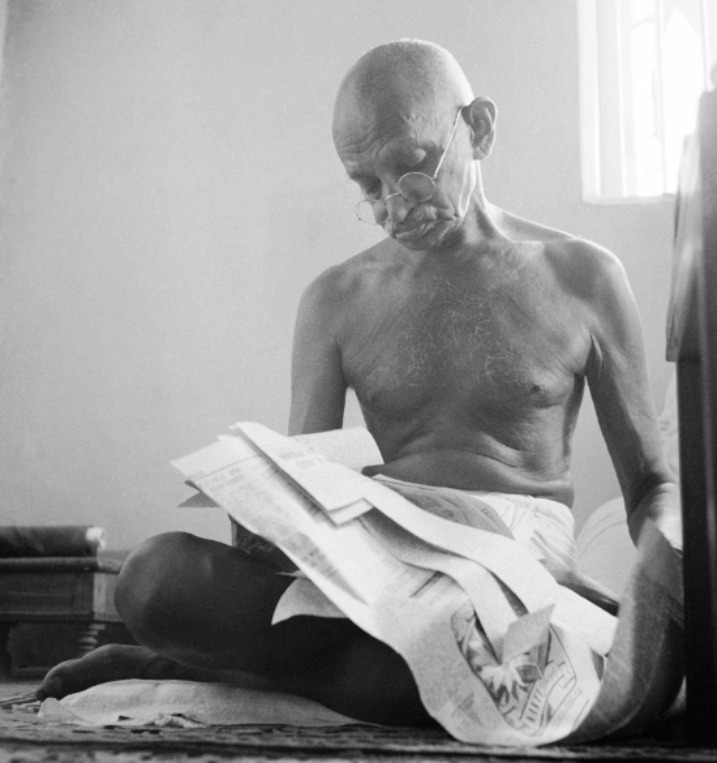
When British repression had sharpened India’s anger and the Rowlatt agitation and Jallianwala Bagh had deepened the crisis, Mahatma Gandhi reached for a weapon that could travel where speeches could not — the press. On September 7, he launched Navajivan as a Gujarati weekly, turning the printed page into a powerful instrument to explain Satyagraha, mobilise public opinion and carry the freedom struggle into ordinary homes.
On September 7, 1919, the first issue of the weekly Navajivan appeared in Gujarati under Gandhi’s editorship. The publication was not entirely new. It had existed in an earlier form as Navajivan ane Satya, associated with Indulal Yagnik, before Gandhi took editorial control and transformed it into a weekly.
The significance of Navajivan lay in what Gandhi expected a newspaper to do. He was not interested merely in producing another periodical carrying political news. He saw journalism as a means of reaching people, explaining ideas, shaping public understanding and maintaining a connection between political leadership and ordinary readers. Navajivan was the Gujarati expression of that effort.
A newspaper born at a turning point
The timing was crucial. Earlier in 1919, Gandhi had launched his opposition to the Rowlatt legislation through Satyagraha. The Rowlatt Bills had been passed despite opposition from elected Indian members, and Gandhi turned to mass political action after constitutional opposition had failed. He travelled to educate people about the implications of the Satyagraha pledge and called for a nationwide hartal.
The campaign was followed by violence in several places, forcing Gandhi to confront a problem that would remain central to his politics: how could a mass movement be built while ensuring that those participating understood the discipline of non-violence?
That question helps explain the importance of Navajivan. Gandhi needed a means through which political ideas could be explained repeatedly, in accessible language, to readers far beyond the circles that followed English-language political debate. A newspaper could reach people between public meetings and political campaigns. It could explain an idea before a movement began, defend a position after an event and communicate instructions when Gandhi could not personally address every group of followers.
Gandhi had already learned the value of journalism during his years in South Africa, where he had edited Indian Opinion. When he decided to convert Navajivan into a weekly, he brought that experience with him. He announced that the new weekly would appear every Sunday and explained its proposed price, format and editorial policy. The first issue was to cost one anna, while the weekly would initially have eight pages.
Gandhi also decided against accepting advertisements for money. His intention was to prevent commercial considerations from determining the character of the newspaper and to keep its purpose centred on public service.
Taking Satyagraha to the vernacular reader
The decision to publish in Gujarati was equally important. Gandhi’s political vocabulary was developing rapidly, but he understood that ideas such as Satyagraha could not become a mass political force if they remained confined to English-speaking readers. The vernacular press provided a bridge between political thought and everyday life.
Gandhi had become increasingly concerned about the misunderstanding surrounding Satyagraha. For him, it was not simply a method of opposing the government. It required truth, self-discipline and a rejection of violence. The events following the Rowlatt agitation demonstrated the difficulty of translating those principles into mass action.
A newspaper offered Gandhi something a speech could not: continuity. A speech reached those present at a particular place and time. A newspaper could be carried home, read again, discussed with others and passed from one reader to another. An argument printed on Sunday could continue influencing conversations throughout the week.
That gave Navajivan a role that went beyond reporting events. It could explain why Gandhi opposed a particular law, what he expected from people joining a movement and why non-violence was essential to Satyagraha.
The newspaper therefore became an instrument of political education.
When readers began writing back
The first weeks of the weekly provide evidence of how quickly it developed a readership. By September 18, 1919, its circulation had reached about 8,500 copies.
By October 7, Gandhi described the five-week-old publication as having “many thousand readers”. But the number alone did not tell the whole story. The same communication revealed that readers were writing to Gandhi about practical matters, including where they could obtain good and cheap seed.
That detail is revealing. It shows that the relationship between the newspaper and its readers was not confined to political discussion. Readers were treating the publication as a channel through which they could raise questions and seek information.
The newspaper was therefore beginning to function as a two-way form of communication. Gandhi wrote to his readers, but readers also responded to him.
This distinction matters when assessing the impact of a newspaper. Influence cannot be measured only by circulation. It is also visible in the relationship that develops between publication and audience. In the case of Navajivan, early correspondence suggests that readers were not passive recipients of Gandhi’s message.
Turning political ideas into public action
Gandhi’s purpose was not simply to tell readers what had happened. He wanted to explain what they should understand from events and how they should respond.
Satyagraha, in his conception, demanded truth, self-discipline and rejection of violence. The experience of the Rowlatt agitation had shown him how easily a mass movement could escape the control of its leaders and descend into violence. Gandhi eventually suspended the campaign after concluding that the people were not sufficiently prepared for the discipline he expected.
A newspaper could help address precisely that problem. It could repeatedly explain the meaning of non-violence, the responsibilities of participants and the difference between Satyagraha and uncontrolled anger.
It could also connect political protest with constructive activity. Gandhi’s public programme was increasingly tied to Swadeshi, indigenous industry, spinning, Hindu-Muslim unity and social reform. These subjects could be carried into homes and communities through a regular vernacular publication rather than being confined to speeches delivered before crowds.
The newspaper therefore occupied an unusual position between politics and social education. It could discuss national questions while also addressing questions of everyday life.
The correspondence concerning seeds illustrates this wider relationship between publication and readership. A reader who encountered Gandhi through the newspaper did not necessarily approach him only as a political leader. The paper could become a source of information, instruction and correspondence.
Why Gandhi wanted an independent press
This was also why the newspaper’s independence mattered to Gandhi.
When he took over Navajivan, he established principles intended to keep the publication independent. It would not accept advertisements for money, and it would not be published at a loss. Gandhi wanted the newspaper to serve the public without turning it into a conventional commercial enterprise.
He also explained that the purpose of Navajivan was to serve people at a time when a “new life” was emerging among them, to guide them through difficult questions and to make complicated matters easier to understand. He urged contributors to write clearly and concisely so readers would receive substance rather than unnecessarily elaborate prose.
That editorial philosophy reveals something important about Gandhi’s understanding of journalism. The newspaper was not merely an instrument for transmitting information from a leader to followers. He wanted it to educate readers.
Its language had to be understandable. Its arguments had to be connected with moral conduct. And its survival had to depend upon readers rather than commercial advertising.
When the colonial government took notice
The colonial government’s relationship with the newspaper adds another dimension to the story.
Navajivan was launched in an atmosphere in which the British authorities were already deeply concerned about political mobilisation and nationalist publications. Gandhi’s correspondence from the period shows that official pressure could create difficulties for the paper, including the possibility that private printers might hesitate to publish it because of government displeasure.
The solution was to strengthen the newspaper’s own printing arrangements.
The episode illustrates the practical vulnerability of nationalist journalism under colonial rule. A newspaper required paper, machinery, printers, declarations and distribution. Government regulations could therefore affect publication without necessarily banning an article outright. Pressure on printers could be as consequential as pressure on editors.
The relationship between the nationalist press and colonial restrictions was part of a wider struggle over public opinion. The Rowlatt agitation had demonstrated how quickly political ideas could spread across India. The Jallianwala Bagh massacre and the imposition of martial law in parts of Punjab further deepened the political crisis.
Navajivan emerged directly inside that atmosphere. It gave Gandhi a regular space in which to interpret events, articulate his response and maintain contact with readers at a time when political communication was itself becoming contested.
A Gujarati paper with a national purpose
Its influence should nevertheless be understood carefully.
It would be historically misleading to suggest that Navajivan alone created the mass nationalist movement or that every revolutionary or political activist in India took his or her ideas from Gandhi’s Gujarati weekly. India’s freedom struggle had many streams, organisations, newspapers and leaders. Revolutionary groups, constitutional nationalists, trade unions, peasant organisations, religious movements and regional political associations operated through different networks.
What can be established is more precise and more significant: Navajivan gave Gandhi a sustained vernacular channel through which his political programme could be explained to a growing readership.
It was one part of a much larger communications network that included Young India, speeches, meetings, correspondence, pamphlets and political organisations.
That network became particularly important as Gandhi moved from the Rowlatt agitation towards the non-cooperation era. The Congress was subsequently reorganised on a broader basis, extending its structure into villages, talukas, districts and provinces. Political activity was increasingly reaching people in small towns and villages.
Navajivan did not independently produce that transformation. But it belonged to the same process of political communication through which nationalism was being carried beyond elite political circles.
Its Gujarati readership gave Gandhi a direct route into a region where he had already built political connections through the Ahmedabad mill workers’ struggle, Kheda Satyagraha and other campaigns.
Two newspapers, different audiences
The importance of the vernacular medium becomes clearer when Navajivan is considered alongside Young India.
The first issue of Young India under Gandhi’s editorship appeared on October 8, 1919, shortly after the launch of Navajivan. The two publications allowed Gandhi to communicate with different sections of India’s politically engaged public.
This was not merely a linguistic distinction. English-language journalism could reach political leaders, educated Indians and international observers, while a Gujarati publication could communicate directly with readers for whom English was not the language of daily political life.
Gandhi was therefore building a broader public conversation through different languages and publications.
The early evidence suggests that Navajivan was particularly successful in reaching readers outside the conventional political elite. Gandhi’s October 7 letter mentioning readers seeking information about seeds is significant precisely because it shows the newspaper’s readership extending into agricultural concerns.
It also demonstrates how Gandhi’s political communication could intersect with questions of rural life and economic self-reliance.
From political message to everyday behaviour
The publication’s approach to Swadeshi was part of the same process.
Gandhi increasingly connected political freedom with economic behaviour. Foreign goods, indigenous production, spinning and later khadi became not merely economic subjects but parts of his wider conception of self-rule.
A newspaper could make these ideas concrete by repeatedly explaining their meaning and connecting them with individual action.
This was one of the distinctive features of Gandhi’s journalism. He did not draw a sharp boundary between political freedom and social reform. The same public that was being asked to oppose unjust laws was also being asked to examine its own conduct, reject untouchability, cultivate communal harmony and accept personal discipline.
The newspaper became a space where these different elements of his programme could appear together.
In this way, political nationalism could be connected with the routines of everyday life. The freedom struggle was not presented simply as something that happened at political meetings or during demonstrations. It could also be expressed through what people bought, produced, wore, practised and believed.
The press becomes part of the freedom struggle
The colonial government, meanwhile, increasingly encountered a nationalist press that could not be separated easily from political organisation.
Gandhi’s correspondence from the period shows him thinking seriously about the legal and financial vulnerability of his publications. He discussed the Press Act and the role of public opinion in securing its repeal, while also insisting on the principles under which Navajivan was operated.
The struggle therefore operated on two levels. Gandhi was trying to persuade readers; the colonial government was trying to regulate a political environment in which persuasion could lead to collective action.
The newspaper became part of that contest over how Indians would understand the country in which they lived and the authority under which they lived.
The importance of this struggle should not be underestimated. A government may suppress a meeting by dispersing a crowd, but a newspaper can carry the argument beyond the place where a meeting was stopped. It can preserve an idea and reproduce it for another audience.
For Gandhi, this made journalism especially valuable.
From a weekly in Ahmedabad to a national movement
The later history of Navajivan shows how closely journalism became tied to the wider freedom struggle.
The publication continued as one of Gandhi’s principal journals, alongside Young India and later Harijan. Its longevity meant that it accompanied several phases of the nationalist movement and remained a regular channel for Gandhi’s political and social views.
Its history also illustrates the growing importance of the printing press itself. Gandhi’s concern in 1919 that a printer might hesitate to publish the newspaper because of government displeasure led to efforts to secure an independent press.
The printing establishment became more than a technical facility. It was part of the infrastructure through which nationalist ideas could be produced and circulated.
By the Civil Disobedience era, the connection between political resistance and the press had become even clearer. Gandhi’s wider campaign against colonial authority in 1930-31 generated an extensive system of communication involving newspapers, pamphlets, speeches and volunteer networks.
The evolution from the weekly launched in 1919 to the mass political communication surrounding Civil Disobedience demonstrates why Gandhi regarded journalism as more than a profession. It was part of the political infrastructure of the movement.
A newspaper that carried a movement’s voice
The significance of Navajivan went beyond Gandhi editing a Gujarati weekly. It gave him a direct channel to explain Satyagraha, non-violence, Swadeshi and self-rule to a growing vernacular readership.
Within weeks, thousands were reading the paper, while readers also wrote back with questions and concerns. It had become more than a publication — it was a conversation between Gandhi and the public.
For Gandhi, that communication was essential to mass politics. People had to understand not only why they were resisting British rule, but how they were expected to resist.
The colonial government’s pressure on the nationalist press further underlined the political importance of newspapers. Controlling the flow of ideas was becoming part of the wider struggle over public opinion.
Navajivan did not represent every stream of India’s freedom movement, but it became a powerful voice for Gandhi’s programme. Its pages helped carry his ideas from political meetings into homes and communities.
In Gandhi’s hands, the press was not merely reporting the freedom struggle. It was helping India understand, organise and participate in it.