
On September 30, 2010, decades of competing claims, historical records and legal battles converged in the Allahabad High Court as it delivered its verdict on the disputed Ayodhya site, marking a defining moment in the long history of the dispute
For a dispute whose roots stretched across the Mughal period, colonial rule and independent India, September 30, 2010 became one of the defining dates in the history of Ayodhya. On that day, the Lucknow Bench of the Allahabad High Court delivered its judgment on the title suits concerning the disputed site where the Babri Masjid had stood until its demolition in December 1992. The judgment did not end the dispute. It was subsequently challenged in the Supreme Court and ultimately set aside in 2019. Yet the date remains important because it marked the point at which decades of competing claims, historical records, religious practices, archaeological material and legal arguments were brought together in a single judicial proceeding.
The significance of September 30 therefore lies not merely in what the three judges decided that day, but in what the judgment represented in the longer history of Ayodhya: an attempt by a constitutional court to adjudicate competing claims over a site where questions of faith, possession, history and property had become inseparable.
A dispute older than the republic
The legal history of the site did not begin in 1950, and certainly not in 2010. The Supreme Court’s 2019 judgment records an earlier suit from January 1885, when Mahant Raghubar Das approached the Sub-Judge at Faizabad seeking permission to construct a temple on the Ramchabutra, a platform in the outer courtyard measuring 17 feet by 21 feet. The trial court dismissed the suit on December 24, 1885, noting the possibility of a breach of peace if construction was permitted. The appeal was dismissed by the District Judge in March 1886, and a further appeal was dismissed by the Judicial Commissioner of Oudh in November that year.
The 1885 case is important historically because it demonstrates that the dispute had already entered the courts during British rule. It also shows that the issue before the court at that time was narrower than the title suits eventually decided in 2010. The Supreme Court later noted that the 1885 litigation concerned construction on the Ramchabutra and did not adjudicate the ownership of the entire disputed premises. The later title suits therefore had a different scope.
The site itself had already developed a complicated history of shared and contested use. The Supreme Court’s historical account records riots in the vicinity in 1856-57, after which the colonial administration erected a grill-brick wall that separated the inner and outer portions of the premises. The inner portion was used by Muslims and the outer courtyard by Hindus. The record also refers to the Ramchabutra and Sita Rasoi in the outer courtyard as places of religious significance for Hindus. The arrangement did not end the conflict, and the court records repeated attempts by one side or the other to exclude the other.
This history is central to understanding September 30. The High Court was not deciding an isolated property dispute that had appeared suddenly before it. It was examining a contested site whose history had accumulated through successive judicial proceedings, administrative orders, religious practices and episodes of conflict.
1949 changed the course of the litigation
A crucial turning point came in the early hours of December 23, 1949, following events on the night of December 22-23. The Supreme Court’s later judgment records that a group of around 50 to 60 people entered the mosque and placed idols of Lord Ram under the central dome. An FIR was registered. On December 29, 1949, the Additional City Magistrate issued proceedings under Section 145 of the Code of Criminal Procedure, 1898, treating the dispute as one likely to lead to a breach of peace. The inner courtyard was attached and a receiver was appointed.
The legal consequences were immediate and long-lasting. On January 16, 1950, Gopal Singh Visharad filed a suit before the Civil Judge at Faizabad seeking a declaration of his right to worship at the site. An interim injunction was issued the same day and modified three days later to prevent removal of the idols and interference with worship.
Other suits followed. Nirmohi Akhara instituted a suit in 1959 concerning management of the site, while the Sunni Central Waqf Board and Muslim residents filed another suit in 1961, seeking declaration of title to the disputed property as a mosque and possession after removal of the idols. In 1989, a further suit was brought on behalf of the deity Bhagwan Shri Ram Virajman and the birth-place described as Asthan Shri Ram Janmabhumi, seeking declaration of title.
These cases eventually formed the core of the litigation that reached the Allahabad High Court.
History entered the evidence room
By the time the case reached its decisive stage before the High Court, the question was no longer capable of being separated neatly into religion, archaeology or property law. The court had to consider evidence from different periods and of different kinds.
The Supreme Court later recorded the scale of the material before the Allahabad High Court. There were 533 exhibits, depositions of 87 witnesses extending across 13,990 pages, and more than 1,000 reference books in Sanskrit, Hindi, Urdu, Persian, Turkish, French and English. The subjects covered history, culture, archaeology and religion. The High Court also received archaeological artefacts, records and electronic material.
The Archaeological Survey of India became an important part of this evidentiary history. In 2002, the High Court directed the ASI to conduct a scientific survey using ground-penetrating technology. After anomalies indicating possible structures were reported, the court directed an excavation in March 2003. A 14-member ASI team was constituted and the excavation was conducted before the ASI submitted its final report on August 22, 2003. The High Court then heard objections to the report.
The archaeological material did not produce a single uncontested historical narrative. The three judges of the 2010 Bench differed on several questions concerning the earlier structure and the history of the site. That distinction is essential when writing about September 30 because the 2010 judgment was not a single judicial interpretation of every historical question. It consisted of separate judgments, with differences among the judges even while a majority agreed on the disposition of the disputed property.
The day the long-awaited judgment arrived
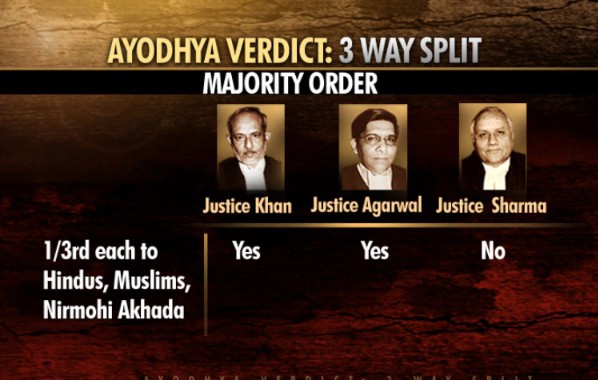
The three-judge Special Full Bench of the Lucknow Bench comprised Justice Sibghat Ullah Khan, Justice Sudhir Agarwal and Justice Dharam Veer Sharma.
The verdict followed extensive hearings. The judges heard arguments over 90 working days between January 11 and July 26, 2010, after which the judgment was reserved. The judges delivered separate judgments and Justice Sudhir Agarwal’s judgment alone ran into more than 5,000 pages.
On September 30, Justices Sibghat Ullah Khan and Sudhir Agarwal formed the majority on the principal question of dividing the disputed premises. Their judgments treated the three sets of litigants as joint holders and provided for one-third shares each to the Muslim parties, the parties representing Ram Lalla and Nirmohi Akhara. Justice Dharam Veer Sharma took a different view and decreed the suit of Ram Lalla in its entirety. The Supreme Court’s 2019 judgment records these positions directly while examining the appeals against the High Court ruling.
The majority’s order was therefore more complex than the shorthand often used to describe it. It provided one-third shares but also specified that the area beneath the central dome, where the idols were located, would go to the Hindu parties in the final decree. Nirmohi Akhara’s share was to include the portions identified as Ram Chabutra and Sita Rasoi. The judgment allowed for minor adjustments while carrying out the physical partition.
The court also ordered that the existing status quo be maintained for three months. The verdict came amid extensive security arrangements across the country, with political and community leaders urging people to maintain peace. Prime Minister Manmohan Singh also appealed against the spread of rumours and efforts to create ill-will between communities.
What September 30 revealed about the dispute
The historical importance of the verdict cannot be reduced to its three-way partition. The judgments themselves demonstrated how deeply the dispute had accumulated competing interpretations of the past.
Justice S.U. Khan, for example, recorded that the disputed structure had been constructed as a mosque under the orders of Babur but also held that direct evidence did not establish that a temple had been demolished specifically to construct it. He described a pre-existing condition of temple ruins and also discussed the historical belief among Hindus concerning the birthplace of Lord Ram. Justice Sudhir Agarwal reached different conclusions on several issues, while Justice Dharam Veer Sharma took the most expansive view of the Hindu claim to the site.
These differences matter because they prevent September 30 from being treated as though the court had produced a single historical account accepted unanimously by all three judges. It did not. The majority agreement concerned the operative division of the site; the judges differed on several historical and legal questions underlying that outcome. Contemporary reports specifically noted differences over whether a temple had been demolished before construction of the mosque and over the character of the earlier structure.
That makes the date historically valuable in another sense. September 30, 2010 captured the accumulated complexity of the Ayodhya dispute in judicial form. Centuries of historical claims could not simply be reduced to one undisputed narrative. They appeared in the form of pleadings, testimony, archaeological reports, documentary material, maps and earlier court decisions.
A verdict, but not the final chapter
The significance of September 30 is also defined by what happened after it.
The 2010 decision did not conclude the legal dispute. Appeals followed, and on May 9, 2011, the Supreme Court stayed the operation of the Allahabad High Court’s order. The disputed land therefore remained subject to judicial proceedings rather than being physically divided according to the 2010 preliminary decree.
The case then moved into a new phase before the Supreme Court. By the time the Constitution Bench delivered its judgment on November 9, 2019, the litigation had accumulated material from a much longer period. The Supreme Court described the dispute as arising from four principal regular suits instituted between 1950 and 1989 and noted that the Allahabad High Court had produced three judgments running to 4,304 pages.
The 2019 judgment rejected the High Court’s three-way bifurcation as legally unsustainable. It held that the disputed property, measuring about 1,500 square yards, should not be divided in that manner. The court directed that the disputed inner and outer courtyards be handed over for the construction and management arrangements contemplated in its judgment, while directing that five acres of suitable land in Ayodhya be allotted to the Sunni Central Waqf Board for construction of a mosque.
The Supreme Court also directed the Central Government to formulate a scheme for setting up a trust or appropriate body to manage the land and oversee matters including construction of a temple. It further directed that Nirmohi Akhara be given appropriate representation in the trust or body in view of its historical presence at the site, while dismissing its suit as barred by limitation.
The 2019 judgment thus changed the legal outcome of the September 30, 2010 ruling. For that reason, the High Court judgment should be remembered neither as the final settlement of the Ayodhya dispute nor as an isolated judicial event. Its importance lies in its place within the long sequence that eventually reached the Supreme Court.
why September 30 assumes importance in Indian history
Dates in history often become important because of what they close, what they begin or what they reveal. September 30, 2010 belongs to all three categories.
It closed one major stage of the Ayodhya litigation by bringing the principal title suits to judgment before the Allahabad High Court. It opened another stage because the verdict was appealed and the dispute continued before the Supreme Court. And it revealed, in extraordinary detail, how a question rooted in religious belief and historical memory had developed into a vast evidentiary and constitutional contest.
The day also provides a window into the changing nature of the dispute across time. The 1885 case concerned construction on a particular platform. The suits filed after 1949 addressed worship, management and title. By the 1980s and 1990s, the case had become part of a much larger national controversy. Following the demolition of the mosque on December 6, 1992, the Central Government acquired approximately 68 acres under the Acquisition of Certain Area at Ayodhya Act, 1993. In 1994, the Supreme Court’s Constitution Bench in Ismail Faruqui v. Union of India invalidated the provision that would have abated the pending suits, allowing the title litigation to proceed.
By 2010, therefore, September 30 represented the product of generations of litigation rather than one isolated moment. It was a date when the historical record of the site, its religious claims and its legal history were brought together before a constitutional court.
The later 2019 judgment makes this continuity explicit. Its opening account traces the dispute across Mughal rule, colonial rule and the constitutional era, placing the modern litigation within a much longer historical arc.
The enduring significance of September 30, 2010 is consequently found not in a simple declaration of victory or defeat. It lies in the fact that, for the first time after decades of litigation, the Allahabad High Court placed a comprehensive judicial determination on record. The decision exposed both the enormous volume of evidence surrounding Ayodhya and the difficulty of reaching a common judicial interpretation of its past.
Nine years later, the Supreme Court would take a different legal route and issue the final judicial determination. But that later chapter does not erase September 30. It gives the date its proper historical place: a major milestone in the transformation of the Ayodhya dispute from a conflict carried across generations into one of the most extensively documented legal contests in modern Indian history.