
How India’s centuries-old heritage is becoming a global economic powerhouse
For centuries, India’s villages have preserved traditions that cannot be replicated elsewhere. From the aroma of Darjeeling Tea to the intricate weave of Banarasi silk, from Kannauj’s perfume makers to Kashmir’s saffron growers, generations have passed down knowledge that is rooted in geography, climate, craftsmanship and culture. Today, these regional treasures are no longer just symbols of heritage—they are becoming global brands.
In 2026, Geographical Indication (GI)-tagged products have once again entered the spotlight as India pushes traditional products into international markets. Recent exports of GI-tagged Rewa Sundarja Mangoes to the UAE, Salem Sago to Canada, and Karnataka’s Nanjangudu Rasabale bananas to the Maldives demonstrate how India’s heritage products are increasingly finding premium buyers overseas. Government agencies such as APEDA are actively linking farmers and artisans with global markets, transforming traditional livelihoods into export opportunities.
This journey, however, began much earlier.
What is a GI Tag?
A Geographical Indication (GI) is a form of intellectual property that identifies products originating from a specific geographical region where certain qualities, reputation or characteristics are essentially linked to that location.
Unlike trademarks, a GI does not belong to a single company or individual. Instead, it protects an entire community of producers.
When consumers purchase Darjeeling Tea or Kanchipuram Silk, they are buying authenticity—not merely a product.
India’s GI Journey
India enacted the Geographical Indications of Goods (Registration and Protection) Act, 1999, which came into force in 2003 to comply with international trade obligations under the WTO’s TRIPS Agreement.
The country’s first GI registration was awarded to Darjeeling Tea in 2004, setting a benchmark for protecting India’s regional products from imitation.
Over the next two decades, hundreds of products—from agricultural produce and textiles to handicrafts and food items—received GI recognition.
Today, India has more than 600 registered GI products, making it one of the world’s richest repositories of geographically protected goods.
From Protection to Prosperity
Initially, GI tags were viewed primarily as legal protection against counterfeit products.
Today, they are increasingly seen as tools for economic development.
Governments, exporters and producer groups are using GI certification to create premium brands that fetch higher prices in domestic and international markets.
Recent exports illustrate this shift:
· GI-tagged Rewa Sundarja Mangoes earned farmers ₹40–50 more per kilogram through export markets than local sales.
· Karnataka’s GI produce reached the Maldives through its first dedicated air shipment, providing farmers significantly higher returns.
· Salem Sago entered Canada directly through an authorised producer society, strengthening local manufacturing and farmer incomes.
The GI tag has thus evolved from a legal certificate into a passport for international trade.
Protecting Traditional Knowledge
Many Indian crafts have survived only because artisans preserved specialised techniques over generations.
Without legal protection, cheaper machine-made imitations often flooded markets, threatening these traditional industries.
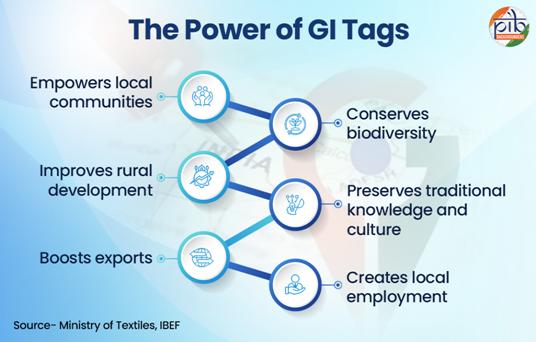
GI registration safeguards:
· Traditional craftsmanship
· Indigenous farming practices
· Regional biodiversity
· Cultural identity
· Local employment
It also prevents misuse of famous names by producers outside the designated geographical area.
States Competing Through Heritage
The race for GI registrations has become a new measure of cultural and economic strength.
Several states have established dedicated GI promotion cells to identify products deserving protection.
According to recent data:
· Uttar Pradesh has emerged as the state with the highest number of GI registrations.
· Tamil Nadu remains among the leaders with a diverse portfolio.
· West Bengal ranks third overall and leads India in food-related GI products, including Darjeeling Tea, Gobindobhog Rice and Joynagar Moa.
Rather than competing through industries alone, states are increasingly competing through heritage.
The Global Demand for Authenticity
Across the world, consumers are willing to pay premium prices for products whose origin can be verified.
Just as Champagne belongs only to France or Parmigiano-Reggiano to Italy, India’s GI products offer internationally recognised authenticity.
For global consumers, GI products represent:
· Traceability
· Quality assurance
· Sustainable production
· Cultural uniqueness
This growing preference has opened new export opportunities for India’s rural economy.
Farmers and Artisans at the Centre
Perhaps the greatest beneficiaries of GI expansion are rural producers.
Unlike large industrial brands, GI products are community-owned assets.
When exports increase, the benefits flow directly to:
· Farmers
· Weaver cooperatives
· Tribal communities
· Handloom artisans
· Traditional craft clusters
Government agencies are increasingly helping these producer groups improve packaging, branding, certification and export logistics to ensure they can compete internationally.
Challenges That Remain
Despite impressive growth, several issues continue to limit the potential of GI products.
Many consumers remain unaware of GI certification.
Counterfeit products still circulate widely.
Small producers often struggle with:
· Marketing
· Digital sales
· International packaging standards
· Export compliance
· Branding expertise
Experts argue that obtaining a GI tag should be seen as the beginning—not the end—of building a successful regional brand.
Beyond Agriculture
Although agricultural products receive significant attention, India’s GI ecosystem extends far beyond farming.
Registered products include:
· Banarasi Sarees
· Channapatna Toys
· Madhubani Paintings
· Blue Pottery
· Kutch Embroidery
· Pashmina
· Mysore Silk
· Bidriware
· Aranmula Mirrors
Together, they represent India’s extraordinary cultural diversity.
GI Tags and the “Vocal for Local” Movement
The government’s “Vocal for Local” initiative has given GI products renewed momentum.
Prime Minister Narendra Modi has frequently showcased GI-tagged products during international visits and diplomatic exchanges, helping introduce India’s regional specialties to global audiences. Recent gifts to world leaders have included several GI-certified foods and agricultural products, reinforcing their role in cultural diplomacy.
The message is clear: local products can become global brands without losing their traditional identity.
Looking Ahead
India’s GI story is entering a new phase.
The focus is shifting from simply registering products to building internationally recognised brands that combine heritage with innovation.
As exports expand and digital commerce reaches even remote producer communities, GI products are expected to play an increasingly important role in rural development, tourism, entrepreneurship and India’s soft power.
The challenge now is not merely to preserve tradition, but to ensure that tradition generates prosperity for the communities that have safeguarded it for centuries.
From handcrafted textiles to fragrant rice, from tribal honey to heritage mangoes, every GI tag carries a promise—that the value of tradition can be measured not only in history, but also in livelihoods, global recognition and sustainable economic growth.
In an era where consumers seek authenticity over mass production, India’s GI-tagged products are proving that the country’s oldest traditions may well be its newest engines of growth.


