
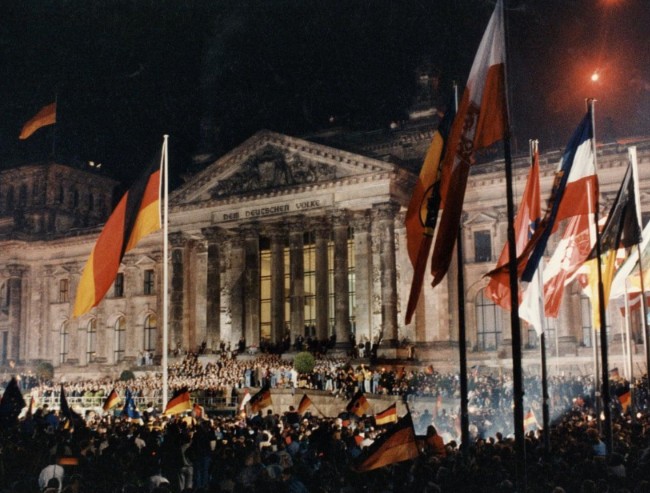
Few dates in modern European history carry the weight of October 3, 1990. On that day, after more than four decades of political division, Germany became one country again. The reunification marked the formal end of a division that had emerged from the aftermath of the Second World War and had subsequently become one of the defining features of the Cold War. Every year on October 3, Germany observes the Day of German Unity, or *Tag der Deutschen Einheit*, as its national holiday. The date does not commemorate the fall of the Berlin Wall, which took place on November 9, 1989, but the formal reunification of the two German states nearly 11 months later.
The story of German unity was shaped by war, ideological rivalry, divided families, political repression, popular protest, democratic elections and international diplomacy. The country that was reunited in 1990 had spent 41 years as two separate states: the Federal Republic of Germany, commonly known as West Germany, and the German Democratic Republic, or GDR, commonly known as East Germany. Their reunification was made possible by a dramatic sequence of events in 1989 and 1990, when political developments inside East Germany coincided with profound changes across Eastern Europe and a transformation in Soviet policy under Mikhail Gorbachev.
A country divided after the Second World War
The origins of Germany’s division lay in the defeat of Nazi Germany in 1945. After the Second World War ended in Europe, Germany was divided into four occupation zones administered by the United States, the Soviet Union, Britain and France. Berlin, although situated inside the Soviet occupation zone, was also divided among the four victorious powers. The arrangement was initially intended to facilitate the administration of defeated Germany, but growing tensions between the Soviet Union and the Western Allies soon transformed the occupation zones into the front line of a wider ideological confrontation.
In 1949, the division became institutionalised with the establishment of two German states. The Federal Republic of Germany was founded in the western occupation zones, while the German Democratic Republic was established in the Soviet occupation zone. The two states followed fundamentally different political and economic systems. West Germany developed as a parliamentary democracy with a social market economy and became increasingly integrated with Western Europe and the transatlantic alliance. East Germany developed as a socialist state under the leadership of the Socialist Unity Party and became closely aligned with the Soviet Union.
Berlin remained a particularly sensitive point because the city itself was divided even though it lay deep inside East German territory. During the early years of the division, large numbers of East Germans travelled through Berlin to reach the West. The continuing movement of people became a major problem for the East German authorities, who viewed the departure of citizens as a threat to the state. On August 13, 1961, East German authorities began closing the border between East and West Berlin and constructed the barrier that would become known as the Berlin Wall.
The Berlin Wall becomes the symbol of division
The Wall quickly became the most recognisable symbol of the Cold War. Concrete barriers, fences, watchtowers and armed border guards divided neighbourhoods and separated families and friends. Attempts to cross the border could result in arrest or death. For Western observers, the Wall represented the restrictions imposed by communist governments in Eastern Europe, while for East German authorities it was presented as a protective barrier against Western influence. Whatever its official description, its physical presence demonstrated the depth of Germany’s political division.
For decades, reunification remained an aspiration for many Germans, but the international circumstances appeared to make it extremely difficult. The division of Germany was closely connected to the wider division of Europe, and any fundamental change in Germany had implications for both the Soviet Union and the Western powers. By the 1980s, however, the political environment in Eastern Europe began to change. Economic difficulties, reform movements and growing public dissatisfaction were putting pressure on communist governments, while developments inside the Soviet Union under Gorbachev created greater space for political change.
Gorbachev became General Secretary of the Communist Party of the Soviet Union in 1985 and introduced policies associated with *glasnost*, meaning greater openness, and *perestroika*, referring to restructuring. His approach differed from the rigid political control that had characterised earlier periods of Soviet rule. Across Eastern Europe, reform movements and opposition groups increasingly challenged established communist governments. Poland’s Solidarity movement had already demonstrated the power of organised public opposition, while Hungary began dismantling parts of its border infrastructure with Austria in 1989.
Growing protests put East Germany under pressure
These developments had a direct effect on East Germany. East German citizens began travelling to Hungary and other countries, creating new routes to the West. At the same time, dissatisfaction inside the GDR was becoming increasingly visible. Citizens demanded greater political freedom, freedom of movement and democratic reform. Peaceful demonstrations began attracting growing numbers of people, particularly in Leipzig, where Monday demonstrations became a major feature of the protest movement.
The East German government struggled to respond to the growing pressure. The leadership had long relied on strict political control, but the developments elsewhere in Eastern Europe and the changing position of the Soviet Union weakened the old system’s ability to maintain the status quo. Demonstrators continued to gather despite the possibility of state intervention. By the autumn of 1989, the protests had become too large to ignore.
November 9, 1989: The Wall opens
The decisive breakthrough came on November 9, 1989. At a press conference, East German Politburo member Günter Schabowski announced new regulations concerning travel by East German citizens. When asked when the rules would take effect, Schabowski indicated that they would apply immediately. The announcement was broadcast widely, and thousands of people soon gathered at Berlin’s border crossings. The border guards were confronted with rapidly increasing crowds and eventually opened the crossings.
The Berlin Wall had effectively fallen. People from East and West Berlin crossed freely, embraced one another and gathered on the Wall itself. Crowds celebrated throughout the city, while people used hammers and other tools to break pieces from the concrete barrier. Images of the celebrations travelled around the world and became among the most powerful pictures of the end of the Cold War.
The fall of the Berlin Wall, however, was not the same as German reunification. It opened the way for reunification but did not determine how or when it would happen. The political process that followed moved at extraordinary speed. East Germany’s political leadership changed, opposition groups became increasingly influential and discussions about the country’s future intensified. What had initially been a movement demanding political reform increasingly became a movement connected to the question of national unity.
The first free election in East Germany
A crucial step came on March 18, 1990, when East Germans participated in the first free and democratic election to the GDR’s Volkskammer, or People’s Chamber. The election fundamentally altered the political landscape. The new parliament had to address the future of East Germany at a time when economic, political and public pressure for closer integration with West Germany was growing rapidly.
The two German states moved towards economic integration even before political reunification was completed. On July 1, 1990, a monetary, economic and social union came into force, with the Deutsche Mark becoming the currency in East Germany. The measure was intended to accelerate economic integration but also demonstrated how quickly the two systems were being brought together.
October 3 chosen as the date of reunification
The question of political reunification was settled through a combination of domestic constitutional decisions and international negotiations. On August 23, 1990, the East German Volkskammer voted by a large majority for the accession of the GDR to the Federal Republic under Article 23 of the West German Basic Law. The parliament set October 3 as the date on which the accession would take effect. This decision gave the reunification process a precise legal and political timetable.
The domestic negotiations were accompanied by a much more complicated international process. Germany’s post-war status meant that the four victorious powers of the Second World War — the United States, Soviet Union, Britain and France — still had important interests in the country’s future. A united Germany also raised questions about its borders, sovereignty, military forces and international alliances.
The Two Plus Four talks settle international questions
These questions were addressed through negotiations that became known as the Two Plus Four talks, involving the two German states and the four Allied powers. The negotiations represented an extraordinary diplomatic process because the future of Germany could not be determined solely by the governments in Bonn and East Berlin. The Soviet Union, in particular, had to agree to the conditions under which a united Germany would exist.
The talks culminated in the Treaty on the Final Settlement with Respect to Germany, signed in Moscow on September 12, 1990. The treaty addressed Germany’s external borders and sovereignty and established arrangements concerning the country’s armed forces and the withdrawal of Soviet troops from eastern Germany. The settlement cleared the way for Germany to regain full sovereignty following reunification.
Meanwhile, the two German governments were finalising the internal legal arrangements. The Unification Treaty was signed on August 31, 1990, by West German Interior Minister Wolfgang Schäuble and East German State Secretary Günther Krause. It established the legal framework through which the GDR would join the Federal Republic and provided for the re-establishment of five eastern Länder: Brandenburg, Mecklenburg-Western Pomerania, Saxony, Saxony-Anhalt and Thuringia.
The treaty also established October 3 as the Day of German Unity and a statutory public holiday. The date therefore became significant not because the Berlin Wall fell on that day, but because it was the date on which German reunification formally took effect.
Midnight on October 3, 1990
On October 3, 1990, the German Democratic Republic ceased to exist as a separate state. Its territory and population became part of the Federal Republic of Germany. Berlin, which had been divided for decades, became a united city within the Federal Republic. At midnight, the German flag was raised outside the Reichstag in Berlin as crowds gathered to celebrate the historic moment.
The ceremony was deeply symbolic. The Reichstag had been one of the most important buildings in German political history, while Berlin had been the central geographical symbol of Germany’s division. The raising of the flag at the moment of reunification therefore represented the transformation of a city and a country that had spent decades at the centre of the Cold War.
Helmut Kohl and the political road to unity
The reunification process was closely associated with West German Chancellor Helmut Kohl, who became one of its most prominent political figures. Kohl had presented a ten-point programme in November 1989 outlining a possible path towards greater cooperation and eventual unity. As events accelerated, his government worked with East German leaders and the governments of the Allied powers to establish the conditions for reunification.
Kohl’s role, however, was only one part of a much wider process. The events of 1989 were driven substantially by citizens of East Germany who took to the streets and demanded change. The peaceful demonstrations, the opening of the Wall, the first free election and the political decisions of the Volkskammer were all essential parts of the process. Without the pressure for reform and democratic participation inside the GDR, the diplomatic negotiations alone could not have produced reunification in the same way.
The Soviet Union’s position was equally important. A united Germany raised the question of whether the country would remain divided between East and West in military terms or become part of the Western alliance. The eventual settlement allowed united Germany to remain a member of NATO while establishing arrangements concerning Soviet forces in eastern Germany. The agreement demonstrated the extent to which German reunification was inseparable from the broader transformation of European security.
Reunification reshapes Europe
The end of Germany’s division also had enormous consequences for Europe. For more than four decades, Germany had been one of the principal geographical and political fault lines of the Cold War. West Germany belonged to the Western bloc, while East Germany belonged to the Soviet-led Eastern bloc. Berlin had become the clearest physical representation of that division.
When Germany reunited, the European order was changing rapidly. Communist governments across Eastern Europe were collapsing or undergoing fundamental transformation. The Soviet Union itself would dissolve in December 1991. Germany’s reunification was therefore part of a much broader transition that transformed the political map of Europe.
Why October 3 and not November 9?
The significance of October 3 becomes clearer when it is distinguished from November 9. The fall of the Berlin Wall was the dramatic breakthrough that captured global attention, but it was not the legal act that reunited Germany. Between the two dates came a series of political and diplomatic developments that turned the opening of the border into a formal reunification.
The distinction also explains why Germany chose October 3 rather than November 9 as its national holiday. November 9 has multiple meanings in German history, including darker ones, and the date was already associated with other major events. October 3 provided a clear constitutional anniversary: it was the day on which the reunification legally took effect.
Before reunification, West Germany had observed June 17 as the Day of German Unity. The date commemorated the 1953 uprising in East Germany, when workers and others protested against the government before the uprising was suppressed with the intervention of Soviet forces. After reunification, October 3 replaced June 17 as the national day.
The first all-German election
The first all-German federal election followed on December 2, 1990. Germans in the former East and West participated in a common federal election, completing another important stage of the political integration of the two former states. Yet the legal creation of a united Germany did not mean that the economic and social differences accumulated over four decades disappeared overnight.
East and West Germany had developed different economic structures, institutions and social experiences. The integration of the two systems brought significant changes to employment, industry, public administration and everyday life in the eastern Länder. The process of adjustment continued long after the celebrations of 1990 had ended.
Unity was a beginning, not an ending
That continuing process is an important part of understanding German Unity Day. October 3 commemorates a specific historical event: the formal reunification of Germany. It does not mean that every social, economic or cultural difference between eastern and western Germany disappeared on that date. Rather, the day marks the beginning of a new phase in which those differences were addressed within a single democratic state.
The symbolism of Berlin remains central to the holiday. Places that once represented division have become reminders of reunification. The Brandenburg Gate, which stood near the Berlin Wall during the Cold War, became a symbol of a united capital. Sections of the Wall that remain today serve as historical reminders of the years when Berlin was physically divided.
The story of German reunification is also notable because it was achieved without a war between the two German states. The political system of East Germany collapsed through a combination of public protest, political change, economic pressure and international developments. The final reunification was then completed through constitutional decisions and diplomatic negotiations.
That does not mean the process was simple or without disagreement. There were debates about the speed of economic integration, the legal route to unity and the future structure of the reunited country. The rapid transformation also created difficult economic and social consequences, particularly in the eastern Länder. These issues became part of the long-term experience of reunification.
October 3 and the making of modern Germany
Yet the historical fact remains that a country which had been divided for 41 years became one state again on October 3, 1990. The process had moved from the streets of Leipzig and other East German cities to the negotiating rooms of Bonn, Berlin and Moscow in less than a year.
The date also illustrates how quickly apparently permanent political structures can change. At the beginning of 1989, the Berlin Wall still stood. East Germany remained a Soviet-aligned state, and the division of Germany appeared to be an established feature of European politics. By the end of the following year, the Wall was gone, East Germany had ceased to exist and Germany was once again a single state.
German Unity Day is therefore a national holiday rooted in a chain of events rather than one isolated moment. It recalls the courage of citizens who demanded change, the opening of the Berlin Wall, the first free election in East Germany, the decisions of the Volkskammer, the negotiations between the two German states and the international diplomacy that secured agreement among the former Allied powers.
Most importantly, October 3 marks the moment when the political division created in the aftermath of the Second World War formally came to an end. The raising of the German flag at midnight symbolised more than the disappearance of a border. It marked the conclusion of one of the most dramatic political transformations in modern European history.
The road to reunification had begun with a country divided by war and hardened by the Cold War. It passed through decades of separation, the construction of the Berlin Wall, growing public dissent, political reforms in the Soviet Union, the peaceful demonstrations of 1989, the fall of the Wall and the rapid diplomatic negotiations that followed. On October 3, 1990, those developments culminated in a legal act that restored Germany as a single state.
Today, German Unity Day is observed every October 3 as Germany’s national holiday. The date remains closely associated with the transformation of Berlin, the end of the Cold War division and the reunification of a country whose people had lived under two political systems for more than four decades. While November 9 remains the iconic date of the Berlin Wall’s fall, October 3 is the date that formally completed the journey from division to unity.
In that sense, the significance of German Unity Day lies not merely in the celebration of a national border disappearing. It represents the culmination of a historic process in which political division gave way to democratic choice, peaceful protest and negotiated reunification. At midnight on October 3, 1990, the flags were raised, the crowds gathered and Germany entered a new chapter of its history as one country once again.