
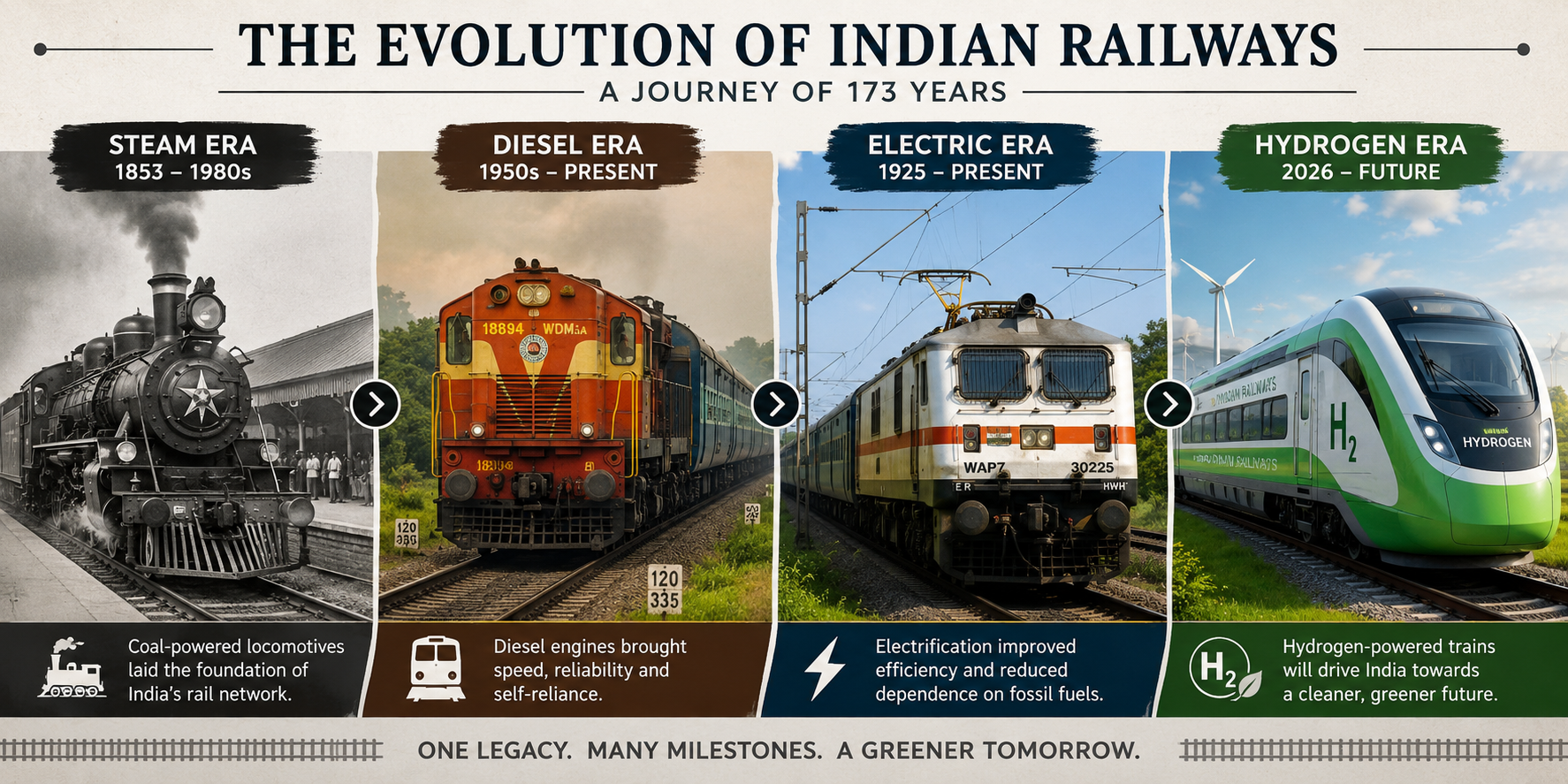
From the steam locomotives of 1853 to the hydrogen-powered trains of the 21st century, Indian Railways has mirrored India’s technological journey. As the country’s first hydrogen train is set to be flagged off on July 17, this is the story of how Indian rail transport evolved from coal-fired engines to clean-energy innovation.
Indian Railways turned a new page in its long and remarkable history. Prime Minister Narendra Modi flagged off India’s first hydrogen-powered train between Jind and Sonipat in Haryana, marking the country’s entry into the global league of nations exploring hydrogen-based rail transport. For many, the event was about a new train and a cleaner fuel. But from a historical perspective, it represents the latest chapter in a story that began more than 170 years ago when the first train steamed out of Bombay.
The journey of Indian Railways is not merely the story of tracks and locomotives. It is the story of technological transformation, economic development, and national ambition. From steam engines to diesel locomotives, from electrification to high-speed trains, each transition has reflected the changing priorities of the nation. Hydrogen trains may now become the symbol of India’s next great railway revolution.
The Beginning: India’s First Train
The history of railways in India began on April 16, 1853, when a train carrying 400 passengers travelled from Bombay’s Bori Bunder station to Thane, covering a distance of 34 kilometres. Pulled by three steam locomotives—Sahib, Sindh, and Sultan—the journey lasted about an hour and fifteen minutes and marked the birth of railway transport in the subcontinent.
The British introduced railways primarily to move raw materials, troops, and goods across the vast territory. Yet what began as a colonial infrastructure project soon became one of India’s most important institutions. Railways connected distant regions, encouraged trade, and brought millions of people into contact with one another.
For more than a century, steam locomotives dominated Indian tracks. Their powerful whistles and billowing clouds of smoke became symbols of modernity and progress. However, steam engines required enormous quantities of coal and water and were expensive to maintain. As technology advanced, Indian Railways began looking for more efficient alternatives.
The Diesel Revolution
Following Independence in 1947, India faced the challenge of modernising its vast railway network. By the 1950s and 1960s, diesel locomotives started replacing steam engines on many routes.
Diesel trains offered several advantages. They were faster, more reliable, and required less maintenance than steam locomotives. They also reduced dependence on large quantities of coal and water. Factories such as the Diesel Locomotive Works in Varanasi became centres of railway manufacturing and innovation.
By the late twentieth century, diesel locomotives had become the backbone of Indian Railways. For a generation of Indians, the sight of red and blue diesel engines pulling long trains across the countryside became a familiar part of daily life.
Yet diesel, despite its advantages, remained dependent on fossil fuels. As environmental concerns grew worldwide, attention increasingly shifted towards cleaner alternatives.
Electrification Changes the Network
While diesel locomotives were expanding across the country, another transformation was quietly underway. Electrification had begun in India as early as 1925, but large-scale expansion accelerated after Independence.
Electric locomotives brought numerous benefits. They were more energy-efficient, capable of hauling heavier loads, and produced fewer emissions than diesel engines. Electrification also reduced dependence on imported petroleum products and improved operational efficiency.
Over the decades, Indian Railways undertook one of the largest electrification programmes in the world. By the 2020s, most major routes had been electrified. The shift represented not only a technological change but also a strategic move towards sustainability.
However, electrification is not always practical everywhere. Some remote, low-traffic, or heritage routes face challenges in installing overhead electric infrastructure. This reality led railway planners to explore another emerging technology: hydrogen propulsion.
The Global Search for Cleaner Trains
The idea of hydrogen-powered transport gained momentum as countries sought ways to reduce carbon emissions. Hydrogen is the most abundant element in the universe and, when used in a fuel cell, produces electricity with water vapour as the only direct emission.
Railways emerged as an attractive area for hydrogen technology. While electric trains are highly efficient, installing electrification infrastructure on every route can be expensive. Hydrogen trains offer a potential solution by carrying their own energy source onboard.
The world’s first commercial hydrogen-powered passenger trains entered service in Germany in 2018. The trains demonstrated that hydrogen fuel-cell technology could successfully power rail transport without producing harmful emissions.
Soon, countries such as Japan, China, South Korea, Spain, France, and the United States began exploring similar projects. Hydrogen trains became symbols of a broader transition towards greener transportation systems.
India was watching these developments closely.
India’s Green Railway Vision
The twenty-first century has seen climate change emerge as one of humanity’s greatest challenges. Governments around the world have pledged to reduce greenhouse gas emissions and move towards cleaner energy sources.
India has set ambitious environmental goals, including achieving net-zero emissions by 2070. Railways, as one of the country’s largest transportation networks, have a critical role to play in this transition.
Indian Railways has already become one of the world’s largest electrified railway systems. Yet policymakers recognised that further innovation would be necessary to create a truly sustainable transport future.
The launch of the National Green Hydrogen Mission gave additional momentum to hydrogen-based technologies. Green hydrogen, produced using renewable energy sources, is viewed as a key fuel for decarbonising sectors that are difficult to electrify directly.
Against this backdrop, Indian Railways began exploring the possibility of hydrogen-powered trains.
The Hydrogen for Heritage Initiative
One of the earliest railway plans involved introducing hydrogen-powered trains on heritage and scenic routes. These routes often operate in environmentally sensitive regions where reducing emissions can have significant benefits.
The concept, known as the “Hydrogen for Heritage” initiative, sought to combine technological innovation with environmental responsibility.
The Integral Coach Factory (ICF) in Chennai was entrusted with developing indigenous hydrogen train technology. Engineers worked on adapting railway systems to incorporate fuel-cell propulsion while ensuring safety, reliability, and operational efficiency.
Unlike conventional diesel locomotives, hydrogen trains use fuel cells to generate electricity. Hydrogen stored onboard combines with oxygen from the atmosphere inside the fuel cell. This chemical reaction produces electricity that powers the train’s motors. The only by-product is water vapour.
For a railway system seeking cleaner alternatives, the technology offered significant promise.
The Historic Launch of 2026
The flagging off of the Jind-Sonipat hydrogen-powered train in July 2026 represents the culmination of years of planning, research, and testing.
The event is significant not only because it introduces a new train service but because it demonstrates India’s ability to develop and deploy advanced railway technology domestically.
The launch places India among a select group of nations experimenting with hydrogen rail transport. It also aligns with broader national initiatives promoting green energy, technological self-reliance, and sustainable infrastructure.
Just as the first steam train symbolised the arrival of the industrial age in India, the hydrogen train may come to symbolise the country’s transition into a cleaner and more environmentally conscious era.
Challenges Ahead
Despite its promise, hydrogen technology is still evolving.
Producing green hydrogen remains expensive compared to conventional fuels. Building hydrogen production, storage, and refuelling infrastructure requires substantial investment. Safety protocols and maintenance systems must also be developed and standardised.
Experts caution that hydrogen trains are unlikely to replace electrification on heavily used routes where electric traction remains more efficient. Instead, hydrogen may complement existing systems by serving routes where electrification is difficult or uneconomical.
The coming years will determine how successfully India can scale this technology.
A Railway That Mirrors the Nation
Few institutions reflect India’s journey as closely as its railways. The network has witnessed colonial rule, the freedom struggle, Partition, industrialisation, economic reforms, and technological transformation.
Every major railway innovation has reflected the aspirations of its time. Steam locomotives represented industrial progress. Diesel engines symbolised post-Independence modernisation. Electrification reflected efficiency and national development. Hydrogen trains now embody sustainability and the search for cleaner futures.
The launch of India’s first hydrogen-powered train is therefore not merely a transportation milestone. It is part of a larger story about how technology evolves alongside society.
More than 170 years after the first train departed from Bombay, Indian Railways continues to reinvent itself. The fuel may have changed—from coal to diesel, electricity, and now hydrogen—but the mission remains the same: connecting people, driving progress, and carrying the nation forward.
As the hydrogen-powered train rolls through the plains of Haryana, it does more than transport passengers. It carries with it the legacy of India’s railway past and the promise of a greener future. For a nation that has always looked to its railways as engines of transformation, the journey into the hydrogen age has only just begun.