
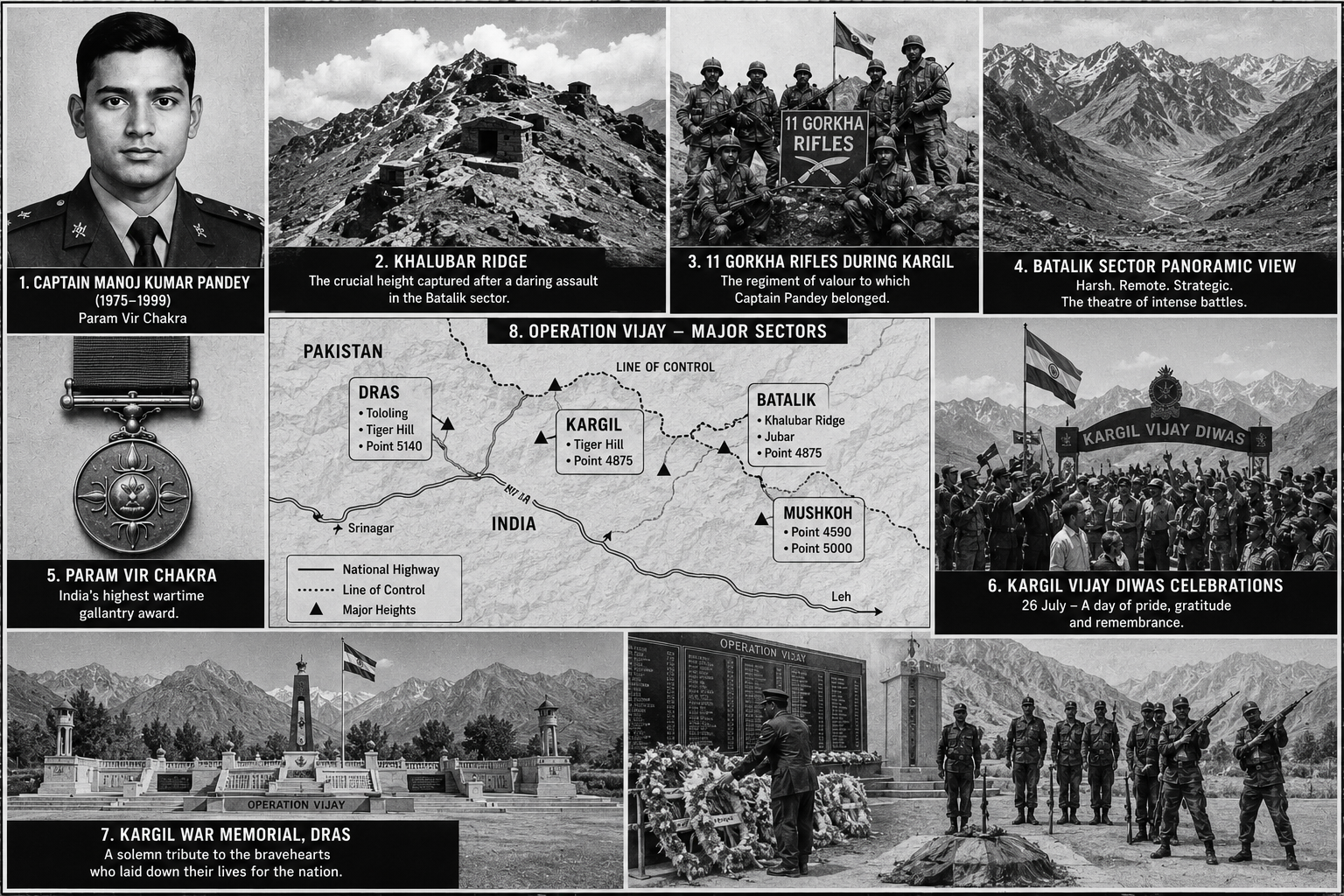
On a freezing night in July 1999, as Indian soldiers climbed steep Himalayan ridges under relentless enemy fire, one young officer refused to retreat despite being grievously wounded. Leading from the front, he charged enemy bunkers, inspired his men to press on, and helped secure one of the most crucial victories of the Kargil War. That officer was Captain Manoj Kumar Pandey, whose extraordinary courage and battlefield leadership became a turning point in India’s campaign to reclaim occupied heights in the Batalik sector.
More than two decades later, Captain Pandey’s story remains one of the most powerful examples of how individual leadership can shape military history. His actions at Jubar and Khalubar not only demonstrated exceptional bravery but also played a strategic role in India’s eventual victory during Operation Vijay.
A Soldier with a Dream
Born on June 25, 1975, in Sitapur district of Uttar Pradesh, Manoj Kumar Pandey grew up with a strong desire to serve the nation. He studied at Uttar Pradesh Sainik School in Lucknow, where he developed a passion for sports, particularly boxing and bodybuilding, and displayed qualities of discipline and determination from an early age.
After successfully completing training at the National Defence Academy (NDA) and the Indian Military Academy (IMA), he was commissioned into the 1st Battalion, 11 Gorkha Rifles, one of the Indian Army’s most distinguished infantry regiments. According to popular accounts, when asked during his Services Selection Board interview why he wanted to join the Army, he replied that he wanted to win the Param Vir Chakra. Few could have imagined that he would one day achieve that goal through supreme sacrifice.
The Kargil Challenge
The Kargil War erupted in 1999 after Pakistani troops and infiltrators occupied strategic heights along the Line of Control (LoC) in Jammu and Kashmir. These positions overlooked vital routes, particularly National Highway 1A connecting Srinagar and Leh, threatening India’s military logistics in the region.
The terrain gave the intruders a major advantage. Occupying heights ranging between 15,000 and 18,000 feet, they could observe troop movements, direct artillery fire, and defend their positions from above. Indian soldiers were forced to launch uphill assaults against fortified bunkers under extremely difficult conditions.
While battles such as Tiger Hill and Tololing became widely known, the Batalik sector witnessed equally fierce fighting. It was here that Lieutenant Manoj Kumar Pandey, later promoted posthumously to Captain, would leave an indelible mark on military history.
The Capture of Jubar Top
One of Pandey’s earliest successes came during operations to recapture Jubar Top, a strategically important feature in the Batalik sector. The position offered a commanding view of surrounding valleys and routes.
As his platoon advanced along a narrow and treacherous ridge, enemy fire brought the attack to a halt. Recognising the danger of remaining exposed, Pandey took the initiative. Ignoring the risk to his own life, he surged ahead through intense gunfire and led a direct assault on enemy positions.
Even after sustaining injuries, he continued advancing, clearing bunkers in close combat and motivating his men to push forward. His fearless charge broke enemy resistance and enabled Indian troops to secure the objective. The capture of Jubar Top strengthened India’s position in the sector and set the stage for further advances.
Why Khalubar Was Crucial
Following the success at Jubar, Indian forces turned their attention to Khalubar Ridge, one of the most heavily defended positions in the Batalik sector.
Khalubar’s importance lay in its geography. The ridge allowed enemy forces to:
· Observe Indian troop movements over a vast area.
· Direct artillery fire with accuracy.
· Protect surrounding positions through interconnected bunkers.
· Delay Indian advances deeper into the sector.
Military planners understood that as long as Khalubar remained under enemy control, operations in Batalik would face serious challenges.
The Strategy That Made the Difference
The battle for Khalubar demonstrated not only Pandey’s courage but also his tactical understanding of mountain warfare.
Rather than relying on a predictable frontal assault, he led his men through difficult terrain to approach enemy positions from an unexpected direction. This element of surprise reduced the effectiveness of enemy fire during the early stages of the attack.
Pandey also recognised that the enemy’s strength lay in a network of mutually supporting bunkers. Capturing one position would achieve little if neighbouring bunkers remained operational. His strategy therefore focused on systematically neutralising multiple enemy strongholds and breaking the defensive chain.
Most importantly, he maintained momentum. In mountain warfare, delays often allow defenders to regroup and strengthen resistance. Despite intense opposition, he ensured the assault continued relentlessly.
The Night of 2–3 July 1999
During the advance toward Khalubar on the night of July 2–3, 1999, Pandey’s platoon came under heavy enemy fire from elevated positions.
Tasked with clearing enemy bunkers that threatened the battalion’s advance, he quickly assessed the situation and reorganised his men. One section was directed to attack from the right flank, while he personally led the assault from the left.
What followed became one of the most celebrated acts of bravery in Indian military history.
Pandey charged the first enemy bunker and eliminated its occupants. He then advanced to the second position and destroyed it despite coming under sustained fire. While attacking the third bunker, he suffered serious injuries to his shoulder and legs.
Most soldiers would have sought medical assistance. Pandey did the opposite.
Ignoring his wounds, he continued leading the attack, urging his men forward. Reaching the fourth enemy position, he destroyed it with a grenade. During this final assault, he was struck by a fatal burst of enemy fire.
According to accounts from fellow soldiers, his last words were “Na Chhodnu”—a Gorkha battle cry meaning “Do not spare them.”
A Turning Point in the Battle
Pandey’s actions broke the enemy’s defensive network and created the firm base required for Indian troops to secure Khalubar Ridge.
The capture of Khalubar had consequences far beyond a single battlefield victory. It weakened enemy control in the Batalik sector, reduced their observation capability, and enabled Indian forces to continue advancing.
Military historians often describe the fall of Khalubar as one of the key tactical successes that contributed to the overall success of Operation Vijay.
The Param Vir Chakra and Lasting Legacy
For his extraordinary bravery, indomitable courage, and devotion to duty, Lieutenant Manoj Kumar Pandey was posthumously awarded the Param Vir Chakra, India’s highest wartime gallantry award. His father, Gopi Chand Pandey, received the medal from the President of India on the nation’s Independence Day celebrations in 1999.
Today, his legacy lives on through institutions, memorials, and military traditions. The National Defence Academy named its science block after him, while residential complexes and roads across India bear his name.
Perhaps his most enduring legacy lies in the inspiration he continues to provide. One of the most quoted lines from his personal diary reads:
“Some goals are so worthy, it’s glorious even to fail.”
The story of Captain Manoj Kumar Pandey is not merely a tale of battlefield heroism; it is a lesson in leadership, determination, and sacrifice. Through his daring assaults at Jubar and Khalubar, he demonstrated how one officer’s courage could influence the outcome of an entire military operation.
The Kargil War was won by the collective efforts of thousands of soldiers, but certain moments stand out as decisive. The capture of Khalubar Ridge was one such moment, and at its heart stood a young officer who chose duty over safety and victory over survival.
In the annals of Indian military history, Captain Manoj Kumar Pandey remains not just a war hero, but a symbol of the spirit that helped India triumph in one of its toughest mountain conflicts.