
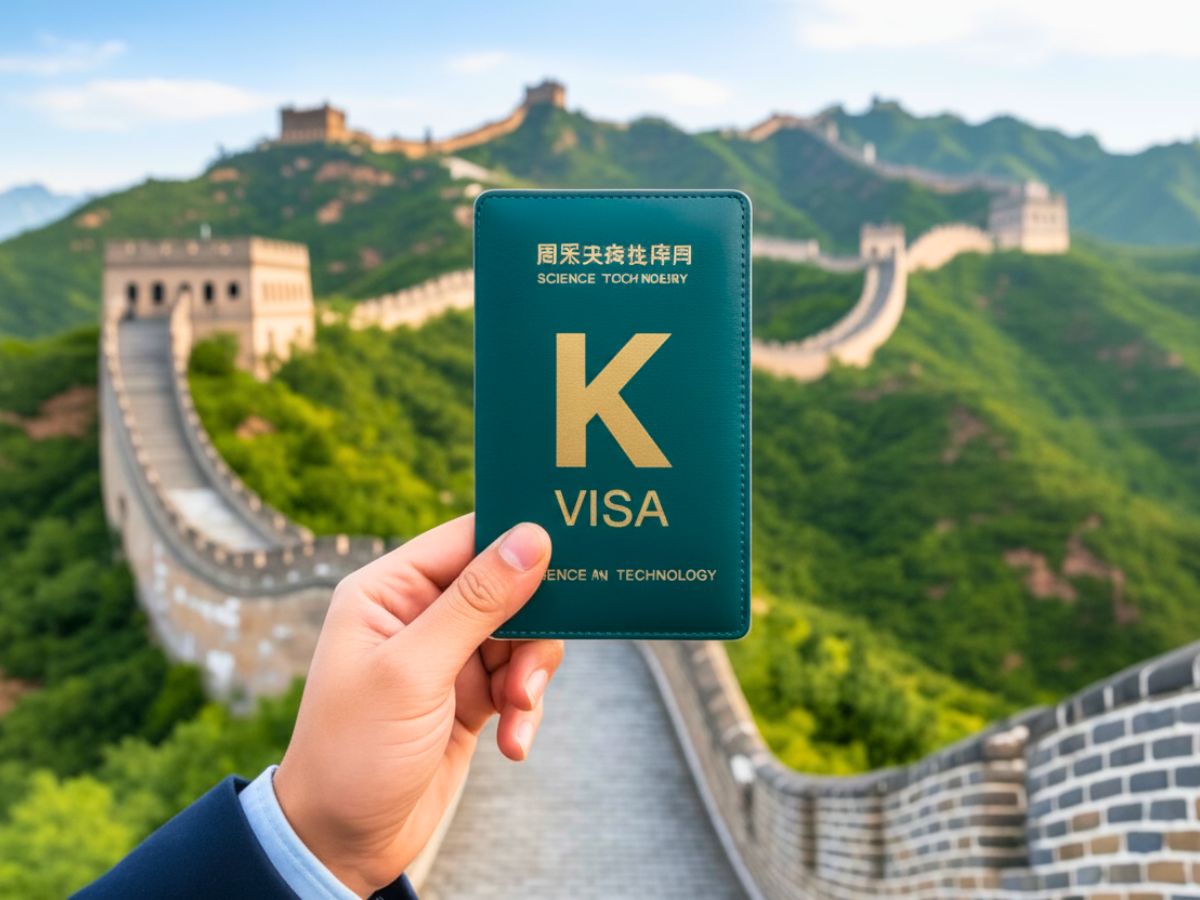
As US President Donald Trump’s new $100,000 H-1B visa fee creates panic and confusion, China has announced a new visa to attract young science and technology professionals. Beijing is adding a K visa to its ordinary visa types, available to eligible young STEM talent.
China’s Premier Li Qiang has signed a decree to amend the rules on foreigners’ entries and exits. According to Xinhua, the new rules will start on October 1, 2025.
What is K Visa by China?
The K visa is a special visa for young foreign professionals in science and technology. It lets them study, do research, work in business, or start projects in China. Unlike other visas, you don’t need an invitation from a Chinese employer, which makes applying easier.
Compared to 12 other Chinese visa types, the K visa gives more flexibility in terms of number of entries, validity, and length of stay.
ALSO READ: China Unveils New ‘K Visa’ As US H-1B Costs Surge: Eligibility, Key Benefits, and Relevance
K Visa Eligibility
To get a K visa, applicants must meet the rules set by Chinese authorities. Requirements include:
- Meeting age, education, and work experience criteria
- Having at least a bachelor’s degree in a STEM field
- Being involved in teaching, research, or business
- Providing proof of qualifications and work experience
- The application process is streamlined and does not require employer sponsorship, making it easy for young professionals to apply.
What does K stand for in K visa?
The “K” in K visa stands for Science & Technology Talent Visa (科技人才签证). It shows that China wants to attract skilled STEM professionals and encourage global innovation.
ALSO READ: China’s K Visa Launches Oct 1: Strategic Pitch to Global STEM Talent Amid H-1B Uncertainty
How Much Does the K Visa Cost?
The exact cost of the K visa has not been announced. But it is intended to be cheaper than the US H-1B visa, lowering financial barriers for talented individuals from around the world.
Duration of the K Visa
The K visa allows multiple entries, longer validity, and extended stays compared to regular visas. Holders can study, research, or work without needing frequent renewals.
K Visa vs H-1B: Key Differences
The K visa has advantages over the US H-1B:
- No employer sponsorship required
- Flexible duration with multiple entries
- Broader scope for study, research, and business
These features make it an attractive option for young STEM professionals looking beyond the US.
ALSO READ: Does the USD 100K H-1B Fee Signal the End of Easy US Work Visas?
Why China Introduced the K Visa Amid H-1B Fee Hike?
The K visa comes after the US introduced a $100,000 H-1B visa fee, effective September 21, 2025, and this has caused confusion and concern among foreign professionals.
India, the largest beneficiary of H-1B visas last year, received 71% of approvals, while China got 11.7%.
China’s K visa offers a timely alternative. Beijing says, “China’s development also provides opportunities for them.” By simplifying rules and procedures, China aims to become a global hub for innovation, research, and talent development.
ALSO READ: US again clarifies Trump’s H-1B proclamation, says existing visa holders not impacted