
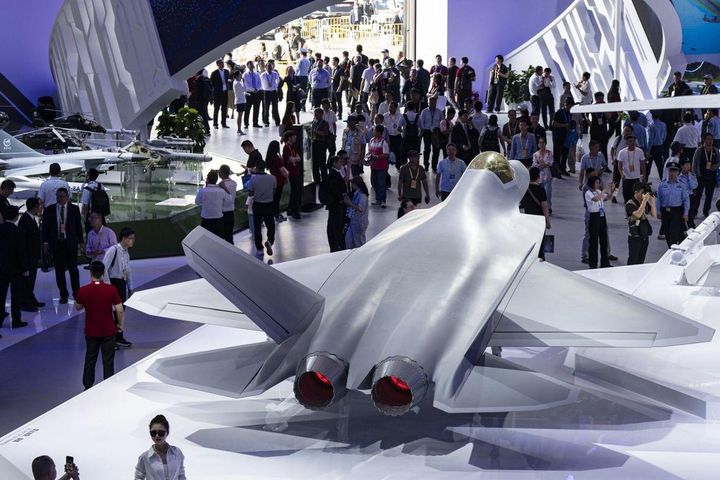
The Shenyang J‑35, China’s second fifth‑generation stealth fighter, is going into serial production and preparation for deployment on the Type‑003 Fujian aircraft carrier, representing a historic step for Chinese naval aviation and regional power projection.
Produced by the Shenyang Aircraft Corporation (AVIC), the J‑35A China’s land-based variant—made its first appearance in the 2024 Zhuhai Airshow, and in July 2025 China announced the beginning of its production for carrier purposes on the Fujian, which is equipped with electromagnetic catapults (EMALS) to enable CATOBAR operations abilities long relegated to the US Navy.
Features & Capabilities
At around 17–18 tons empty, the J‑35 is small but powerful said to carry as many as six air-to-air missiles internally, with domestically made WS‑19 engines powering it. Analysts predict it could possibly provide greater combat radius than its stealth counterparts, though complete avionics and sensor integration are unclear.
Export Push & Regional Concerns
China recently showcased a model of the J‑35 at the 2025 IDEX exhibition in Abu Dhabi with the aircraft being pitched as equal to the US-produced F‑35 and appealing to Middle Eastern customers. It is also reported that Pakistan could be the first foreign purchaser with plans to purchase as many as 40 vehicles although Islamabad’s defence minister subsequently officially denied the report.
Indo-Pacific Balance & India’s Response
For India, the J‑35’s induction into service could revolutionize air power equations in the region. As a twin-engine, carrier-capable stealth fighter, it could potentially provide deep-range air superiority and maritime attack capability for the PLAN Navy. Experts argue that it could trigger New Delhi to expedite its own fifth-generation fighter program whether by AMCA, Su‑57 acquisition, or F‑35 partnership.
Strategic Challenges & the Road Ahead
While the J‑35 demonstrates China’s increasing aerospace maturity, analysts warn that the aircraft continues to trail the US F‑35 by 10–15 years in terms of software integration, network-centric warfare capability, and operational deployment readiness. Moreover, survivability over the long term as well as carrier suitability are untested.
With production begun and carrier deployment planned, the J‑35 makes China the second country in the world to operate a carrier-based stealth fighter. Whether for export or naval supremacy, it is an impressive counterpoint to US air‑sea power. For India, the development necessitates strategic reorientation, and a sense of urgency in developing its own next‑generation fighter force.