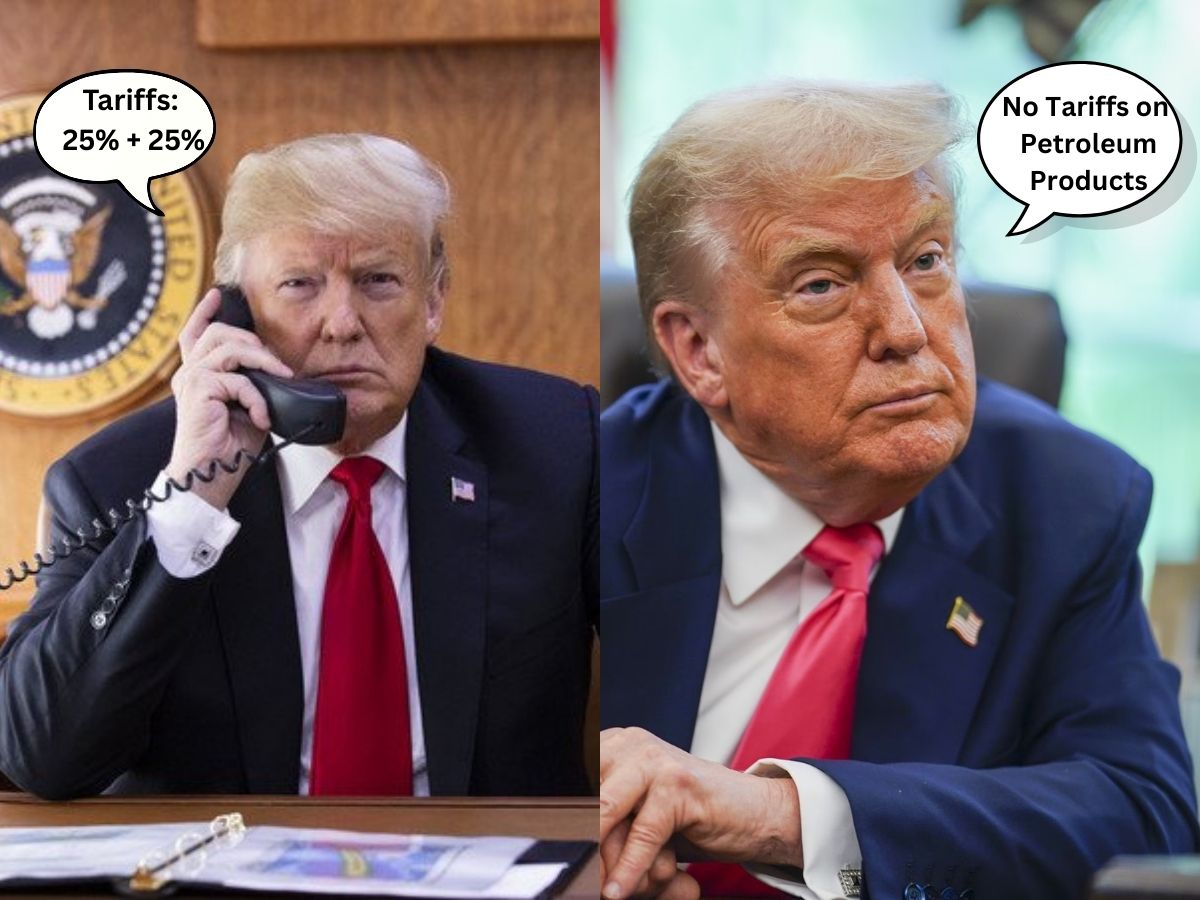
As the Indian exports to US take the hit of 50% tariff from today, petroleum products stand exempted from the imposition.
It all started with 'punishing' India for purchasing Russian oil, tariffs imposed, additional tariffs imposed, foul mouthed blabbers and what not. And the day comes when the Indian exports take the hit of 50% tariffs which was supposed to be wrath-intended from the man himself- POTUS Trump. The US has always presented itself as a strong promoter of free markets and equitable trade, but its policy position on tariffs most times hides a hidden layer of hypocrisy.
As other Indian exports face the dictator-faced tariffs, the hypocrisy and the double standards of US trade policy stands exposed. Though Washington has used tariffs extensively as an instrument of correcting trade deficits or shielding local producers, it has also used it to exempt petroleum exports from India from punitive tariffs on the grounds of lack of viable substitutes. Such preferential application betrays the 'fair' nature of US trade policy.
ALSO READ | ‘Nothing-doing, Mr. Trump’, PM Modi’s Clear Message on Agro-Dairy
Tariffs have been employed by past US governments to intimidate trade partners, supposedly to provide "level playing fields." Whether putting tariffs on Chinese imports or restricting steel and aluminium imports from India and Europe, the pretext has been national interest and protecting local jobs.
But with energy security, the attitude is dramatically opposite. Petroleum products, especially diesel and jet fuel produced in India, are still essential for the US market. US refiners are unable to supply some product qualities because of limitations in capacity and configuration. Imports from India to the US covers this deficiency-gap.
Consequently, Washington has come easily in for a loophole: Indian petroleum goods come into one of the world's largest markets without facing the same attention or tariff volume as elsewhere in US trade policy. The official logic cites "lack of immediate substitutes." Actually, this is an indictment of selective hardness in US trade enforcement- hard on products where US interests prevail, but soft where US supply chains will fail without imports.
ALSO READ | Fed Rate Cut: A Double-edged Sword for the Indian Stock Market
This double standard is compounded yet again by the US's repeated denunciation of India's tariff regime. Washington continually accuses New Delhi of excessive protectionism in areas such as agriculture, dairy products, and automobiles. But its own readiness to set aside principles of 'evenhanded' action when strategic imperatives demand it betrays how tariffs, in the US view, are more a matter of leverage than consistency. It is preaching world rules while shaping exceptions for self-survival.
Furthermore, such discriminatory use threatens credibility. When American negotiators browbeat Delhi to roll back trade barriers in strategic sectors, New Delhi can cite petroleum exceptions as evidence that Washington understands pragmatism over ideological fidelity. It reinforces the Indian case that economic sovereignty and graduated protectionism are as legitimate for emerging economies as they are for America.
ALSO READ | Super 301: The US Tool Against India, As It Plays by Dirty Double Standards
At its core, the paradox highlights a greater truth- international trade regimes are influenced not by intellectual ideals but by unbalanced power and hypocrisy. For US, energy security is more important than 'tariff ideology'. In allowing Indian petroleum through the net of punitive tariffs, Washington reveals the disparity between its rhetoric of fair trade and its reality of convenient exceptions and that the tariff-bullying has its own limitations.