
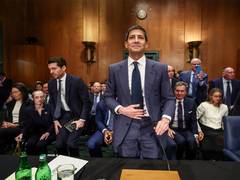
Washington [US], June 18 (ANI): The US Federal Reserve on Wednesday kept its benchmark interest rate unchanged, maintaining the federal funds target range at 3.50-3.75 per cent, concluding the first Federal Open Market Committee (FOMC) meeting chaired by Kevin Warsh since he assumed leadership of the central bank last month.
The decision came against a backdrop of persistent inflation pressures, resilient labour market data and heightened geopolitical uncertainty, factors that have complicated the Fed’s path toward restoring price stability.
“Productivity growth and capital investment are both strong. Economic activity is expanding at a solid pace despite elevated uncertainty. Persistent high prices are a burden for the American people. I have refrained from projections of my own,” Kevin Warsh said.
The Federal Reserve noted strong productivity growth. In a statement, the Fed said that it was a unanimous decision on the rate and acknowledged the uncertainty linked to the West Asia conflict. “Productivity growth and capital investment are strong. Job gains have kept pace with the workforce, and the unemployment rate has changed little,” the Committee said in a press statement.
While the policy decision itself was widely anticipated by financial markets, investors were focused on whether the Fed would signal a shift in its policy stance through updated economic projections and changes to its post-meeting statement.
The June meeting represented an important test for Warsh, who took office amid growing debate over the future direction of US monetary policy. Recent economic data have painted a mixed picture for policymakers.
The US labour market has remained robust, with unemployment holding at 4.3 per cent and job creation continuing at a healthy pace. At the same time, inflation remains well above the Federal Reserve’s 2 per cent target, with consumer prices rising 4.2 per cent year-on-year in May, the highest level in three years.
Against this backdrop, markets entered the meeting expecting the Fed to move away from the easing bias that had characterised previous communications. Several policymakers had recently argued that language referencing “additional adjustments” to interest rates–widely interpreted as signalling future rate cuts–was no longer appropriate given the inflation outlook.
The policy discussion has also been shaped by geopolitical developments. Rising energy prices linked to tensions in West Asia had initially raised concerns about renewed inflationary pressures, though those fears moderated in recent days as hopes for a diplomatic resolution helped push oil prices lower.
Investors closely scrutinised the Fed’s updated Summary of Economic Projections, including the closely watched “dot plot,” for clues about the future path of interest rates.
Attention now turns to Warsh’s inaugural post-meeting press conference, where investors will seek greater clarity on how the new Fed chair intends to navigate the competing challenges of elevated inflation, steady economic growth and a still-resilient labour market. Any signals regarding the future policy framework, communication strategy or the balance of risks facing the economy could prove as significant for markets as the rate decision itself. (ANI)
(The article has been published through a syndicated feed. Except for the headline, the content has been published verbatim. Liability lies with original publisher.)