
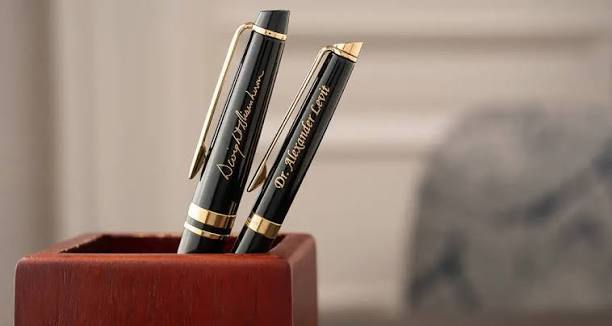
The ballpoint pen is so ordinary that almost nobody stops to wonder where it came from. It sits in every drawer, bag and reception desk, gets lent and lost without a thought, and does its job so quietly that its history seems beside the point. But the story of how the pen in your hand came to exist is genuinely surprising, spanning a Harvard lawyer, a Hungarian newspaper editor fleeing persecution, and a naming quirk that means half the world calls the same object by a different word. For anyone who chooses pens for a living, or simply likes knowing where everyday things come from, it is a story worth telling.
It begins, oddly, with leather rather than paper. In 1888 an American named John Loud, a lawyer by training, patented the first ball-and-socket pen mechanism, a design meant for marking leather and other rough surfaces that ordinary nibs could not handle. It worked for that, but it was far too coarse for writing on paper, and the patent eventually lapsed without ever becoming a product. Loud had the core idea, a rolling ball delivering ink, but not the ink or the precision to make it write properly. The problem that defeated him, getting ink to flow smoothly and dry quickly, would take another half-century and a completely different kind of person to solve.
That person was László Bíró, a Hungarian newspaper editor who, the story goes, noticed that the ink used to print newspapers dried far faster than the ink in his fountain pen, which was forever smudging. Working with his brother György, a chemist, he paired a fast-drying, thicker ink with a tiny rolling ball that delivered it evenly onto the page. The combination was the breakthrough Loud had lacked: an ink viscous enough not to leak but fluid enough to write, metered out by a ball that turned as it moved. Bíró demonstrated an early version at the Budapest International Fair in 1931 and filed a British patent for the refined design in 1938. The modern ballpoint had arrived, and its descendants now fill GoPromotional’s branded pen range in more forms than Loud or Bíró could have imagined.
The name is where the story turns poignant and then charming. Bíró was Jewish, and as anti-Semitic laws tightened in Hungary he fled, reportedly leaving on the very last day before a new law would have banned taking patents out of the country. He eventually settled in Argentina, and there, with a friend named Juan Meyne, he set up in business and named the pen the birome, a blend of Bíró and Meyne. To this day, Argentinians call any ballpoint a birome, while in Britain and much of the Commonwealth the same object is a biro, straight from the inventor’s own surname. It is one of the few everyday products so tied to its creator that his name simply became the word for it, and the fact that two different fragments of the same story survive in two different countries is a small linguistic accident with real history behind it.
The pen most people actually held, though, came from a French manufacturer. In 1950 Marcel Bich licensed the design, refined it for mass production, and launched the Bic Cristal, the clear-barrelled pen that went on to become one of the best-selling products ever made, sold by the million every single day. A few years later, in 1954, Parker released the Jotter, using a hard-wearing textured ball and selling in huge numbers from the start; it has since passed three-quarters of a billion units sold. Between them, these pens turned Bíró’s invention from a clever device into the invisible everyday object it is now, the thing you reach for without looking and lend without thinking.
That last point is where the history becomes useful rather than merely interesting. The reason a pen makes such an effective branded item is bound up in exactly the qualities this story explains: it is genuinely useful, it is used constantly, and it travels. A pen gets picked up, carried, lent to a colleague, left on a counter, pocketed by a stranger, and used long after whoever first handed it over has been forgotten, all while carrying whatever is printed on the barrel. The very ordinariness that makes the ballpoint’s history easy to overlook is what makes a branded one work: it embeds a logo into the small, constant, borrowed transactions of everyday life in a way few other objects manage.
So the next time a branded pen seems like the unglamorous option, it is worth remembering what it actually is: the end point of a century of invention, from a leather-marking patent to a refugee’s fast-drying ink to a French factory’s clear plastic barrel, refined into an object so useful it disappears into daily life. A pen is not a throwaway. It is one of the most quietly successful designs in history, and putting a brand on it puts that brand into the same everyday current the ballpoint has been riding for seventy years.